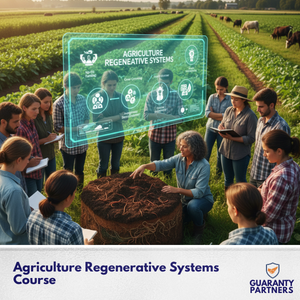
Agriculture Regenerative Systems Course
Course Overview
By the end of this course, participants will be able to:
• Understand the principles and importance of regenerative agriculture.
• Evaluate the ecological and economic benefits of regenerative systems in agriculture.
• Design and implement regenerative agricultural practices tailored to specific environments.
• Enhance soil health, biodiversity, and ecosystem services through practical techniques.
• Incorporate sustainable water management and carbon sequestration strategies into farming.
• Foster resilience in agricultural systems against climate change and market fluctuations.
• Integrate modern technologies, including AI and IoT, into regenerative practices for improved outcomes.
Training Format:In-class, Virtual, In-house
Location:Lagos, Accra, Nairobi, Kigali
Language:English, French
Nigeria Price:
₦430000
Int'l., (Nigeria) Price:
$1000
Ghana Price:
$5000
Kenya Price:
$6500
Rwanda Price:
$7000
Nigeria Price:₦430000
Int'l., (Nigeria) Price:
$1000
Ghana Price:
$5000
Kenya Price:
$5000
Rwanda Price:
$5000
Nigeria Price: ₦430000
Int'l., (Nigeria) Price:
$1000
Ghana Price: $5000
Kenya Price: $5000
Rwanda Price: $5000
Introduction to Regenerative Agriculture
o Definition and key principles.
o Historical context and evolution of regenerative systems.
o Global case studies and success stories.
Soil Health and Management
o Understanding soil biology and chemistry.
o Techniques for improving soil organic matter.
o Practices for reducing erosion and enhancing soil fertility.
Biodiversity and Ecosystem Services
o Role of biodiversity in sustainable farming.
o Strategies for encouraging beneficial flora and fauna.
o Pollination management and pest control through natural methods.
Water Management in Regenerative Agriculture
o Sustainable irrigation practices.
o Techniques for water conservation and rainwater harvesting.
o Mitigating water scarcity and drought impacts.
Crop Rotation and Cover Cropping
o Designing effective crop rotation schedules.
o Benefits and implementation of cover crops.
o Combining agroforestry with crop systems.
Carbon Sequestration and Climate Resilience
o Practices for reducing greenhouse gas emissions in agriculture.
o Building resilience against climate variability.
o Carbon markets and incentives for farmers.
Animal Integration and Holistic Grazing
o Benefits of integrating livestock into regenerative systems.
o Rotational and holistic grazing techniques.
o Managing manure and its role in nutrient cycling.
1ST BATCH: Tuesday, February 23, 2027 — Friday, February 26, 2027.
2ND BATCH: Tuesday, June 22, 2027 — Friday, June 25, 2027.
3RD BATCH: Tuesday, October 12, 2027 — Friday, October 15, 2027.
The training methodology integrates lectures, interactive discussions, collaborative group exercises, and
illustrative examples. Participants will acquire a blend of theoretical insights and hands-on practical
experience, emphasizing the application of learned techniques. This approach ensures that attendees return
to their professional environments equipped with both the competence and self-assurance to effectively
implement the acquired skills in their responsibilities.