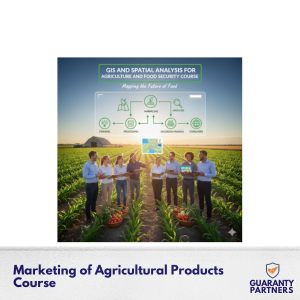
GIS and Spatial Analysis for Agriculture and Food Security

Course Overview

• Understand the fundamentals of GIS and spatial analysis in the context of agriculture.
• Explore the use of GIS for monitoring and managing agricultural resources.
• Analyze spatial data to improve food security planning and decision-making.
• Develop skills to apply GIS tools for sustainable agricultural practices.

Training Format:In-class, Virtual, In-house

Location:Lagos, Accra, Nairobi, Kigali

Language:English, French

Nigeria Price:
₦350000

Int'l., (Nigeria) Price:
$1000

Ghana Price:
$4000

Kenya Price:
$5500

Rwanda Price:
$6000

Nigeria Price:₦350000

Int'l., (Nigeria) Price:
$1000

Ghana Price:
$4000

Kenya Price:
$4000

Rwanda Price:
$4000

Nigeria Price: ₦350000

Int'l., (Nigeria) Price:
$1000

Ghana Price: $4000

Kenya Price: $4000

Rwanda Price: $4000

Introduction to GIS and Spatial Analysis in Agriculture
• Overview of GIS concepts and tools
• The role of spatial data in agriculture and food security
• Key GIS techniques for agricultural analysis
• Types of spatial data and sources (remote sensing, GPS, etc.)
• Applications of GIS in agricultural monitoring and management

Data Collection and Preparation for GIS Analysis
• Methods of collecting spatial data in agriculture
• Preprocessing and cleaning of spatial data
• Introduction to spatial databases and data formats (shapefiles, rasters)
• Integrating data from various sources (satellite imagery, field surveys)
• Creating maps and visualizing agricultural data

Spatial Analysis Techniques for Agriculture
• Buffer analysis and proximity analysis in agriculture
• Terrain analysis and land suitability mapping
• Crop yield prediction using spatial models
• Spatial interpolation and its applications in agriculture
• Identifying spatial patterns in crop health and productivity

GIS Applications in Food Security and Sustainable Agriculture
• GIS in disaster management and risk assessment (droughts, floods)
• Monitoring food production and distribution using spatial tools
• GIS for sustainable land use and agricultural zoning
• Decision-making support for food security policies
• Case studies of GIS applications in agriculture and food security

1ST BATCH: Tuesday, April 7, 2026 — Friday, April 10, 2026.

2ND BATCH: Tuesday, July 28, 2026 — Friday, July 31, 2026.

3RD BATCH: Tuesday, November 24, 2026 — Friday, November 27, 2026.

The training methodology integrates lectures, interactive discussions, collaborative group exercises, and
illustrative examples. Participants will acquire a blend of theoretical insights and hands-on practical
experience, emphasizing the application of learned techniques. This approach ensures that attendees return
to their professional environments equipped with both the competence and self-assurance to effectively
implement the acquired skills in their responsibilities.

Facebook
WhatsApp
X
Threads
Telegram
Print