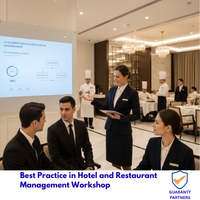
Best Practice in Hotel and Restaurant Management Workshop
Course Overview
When most people think of the hospitality industry, they usually think of hotels and restaurants. However, the true meaning of hospitality is much broader in scope. According to the Oxford English Dictionary, hospitality means “the reception and entertainment of guests, visitors or strangers with liberality and good will.”
Hospitality, then, not only includes hotels and restaurants but also refers to other kinds of institutions that offer shelter, food, or both to people away from their homes. We can also expand this definition, as many people have, to include those institutions that provide other types of services to people away from home. This might include private clubs, casinos, resorts, attractions, and so on.
Training Format:In-class, Virtual, In-house
Location:Lagos, Accra, Nairobi, Kigali
Language:English, French
Nigeria Price:
₦300000
Int'l., (Nigeria) Price:
$1000
Ghana Price:
$4000
Kenya Price:
$5500
Rwanda Price:
$6000
Nigeria Price:₦300000
Int'l., (Nigeria) Price:
$1000
Ghana Price:
$4000
Kenya Price:
$4000
Rwanda Price:
$4000
Nigeria Price: ₦300000
Int'l., (Nigeria) Price:
$1000
Ghana Price: $4000
Kenya Price: $4000
Rwanda Price: $4000
Hospitality Management
– Operating a hotel or catering company
– Projecting comfort and ease
– Elevating your business
– Making a profit
Restaurant Management
– Understand a Kitchen Profit and Loss Account and How expense can be affected
– Plan and Develop a Restaurant Concept
– Fully Understand Food cost and its relationship to profitability
– Understand wastage and its impact on the bottom line
– The principles of cost-effective staff planning
– Kitchen Management
– Setting the Table
– Cost control methods
– The true cost of a recipe
– Different methods to set your selling price
– Conduct a menu analysis study and engineer a menu
Cost Control by Budgeting
– Purposes of Budgeting
– Types of Budgets
– Budget Preparation
– The Budget Cycle
– Departmental Budgets
– Budgeting in A New Operation
Sales & Marketing
– Customer satisfaction
– Attracting and keeping customers
– Understanding the consumer
– Deals, promotions, coupons, etc.
– Procedures Manual
Audit and Accounting Concepts
– Key Skills of an Auditor
– Accounting Function
– Managing Guests Accounts
– Understanding Balance Sheets
– Understanding Cash Flow Statements
– Writing Auditing Reports
– Practical Auditing Exercises
FOR WHOM:
Supervisors, Managers, Chefs, Human Resources Manager
Hospitality Management
– Operating a hotel or catering company
– Projecting comfort and ease
– Elevating your business
– Making a profit
Restaurant Management
– Understand a Kitchen Profit and Loss Account and How expense can be affected
– Plan and Develop a Restaurant Concept
– Fully Understand Food cost and its relationship to profitability
– Understand wastage and its impact on the bottom line
– The principles of cost-effective staff planning
– Kitchen Management
– Setting the Table
– Cost control methods
– The true cost of a recipe
– Different methods to set your selling price
– Conduct a menu analysis study and engineer a menu
Cost Control by Budgeting
– Purposes of Budgeting
– Types of Budgets
– Budget Preparation
– The Budget Cycle
– Departmental Budgets
– Budgeting in A New Operation
Sales & Marketing
– Customer satisfaction
– Attracting and keeping customers
– Understanding the consumer
– Deals, promotions, coupons, etc.
– Procedures Manual
Audit and Accounting Concepts
– Key Skills of an Auditor
– Accounting Function
– Managing Guests Accounts
– Understanding Balance Sheets
– Understanding Cash Flow Statements
– Writing Auditing Reports
– Practical Auditing Exercises
FOR WHOM:
Supervisors, Managers, Chefs, Human Resources Manager
1ST BATCH: Tuesday, February 3, 2026 — Friday, February 6, 2026.
2ND BATCH: Tuesday, May 26, 2026 — Friday, May 29, 2026.
3RD BATCH: Tuesday, September 22, 2026 — Friday, September 25, 2026.
The training methodology integrates lectures, interactive discussions, collaborative group exercises, and
illustrative examples. Participants will acquire a blend of theoretical insights and hands-on practical
experience, emphasizing the application of learned techniques. This approach ensures that attendees return
to their professional environments equipped with both the competence and self-assurance to effectively
implement the acquired skills in their responsibilities.