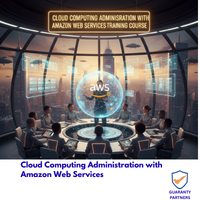
Cloud Computing Administration with Amazon Web Services
Course Overview
• Understand the fundamentals of cloud computing and its benefits
• Learn how to administer and manage cloud infrastructure using Amazon Web Services (AWS)
• Gain practical experience in configuring and deploying AWS services
• Develop skills to optimize cloud resources and ensure cost-effective solutions
Training Format:In-class, Virtual, In-house
Location:Lagos, Accra, Nairobi, Kigali
Language:English, French
Nigeria Price:
₦350000
Int'l., (Nigeria) Price:
$1000
Ghana Price:
$4000
Kenya Price:
$5500
Rwanda Price:
$6000
Nigeria Price:₦350000
Int'l., (Nigeria) Price:
$1000
Ghana Price:
$4000
Kenya Price:
$4000
Rwanda Price:
$4000
Nigeria Price: ₦350000
Int'l., (Nigeria) Price:
$1000
Ghana Price: $4000
Kenya Price: $4000
Rwanda Price: $4000
Cloud Computing Fundamentals
• History and evolution of cloud computing
• Cloud computing models: IaaS, PaaS, and SaaS
• Benefits and challenges of cloud adoption
AWS Global Infrastructure
• AWS Regions and Availability Zones
• AWS Edge Locations and Content Delivery Network (CDN)
Identity and Access Management (IAM)
• Creating and managing IAM users, groups, and roles
• Implementing access control policies
Elastic Compute Cloud (EC2)
• Launching and configuring EC2 instances
• Selecting appropriate instance types and Amazon Machine Images (AMIs)
• Implementing Auto Scaling and Load Balancing
Virtual Private Cloud (VPC)
• Creating and managing VPCs
• Configuring subnets, route tables, and security groups
• Establishing VPN connections and VPC peering
Simple Storage Service (S3)
• Creating and managing S3 buckets
• Configuring object versioning and lifecycle policies
• Enabling static website hosting and cross-origin resource sharing (CORS)
Relational Database Service (RDS)
• Launching and configuring RDS instances
• Selecting appropriate database engines and instance classes
• Implementing Multi-AZ deployments and Read Replicas
CloudWatch
• Monitoring EC2 instances and other AWS resources
• Creating alarms and setting up notifications
• Analyzing logs and generating custom metrics
CloudTrail
• Tracking user activity and API usage
• Monitoring AWS service events and configuration changes
AWS Lambda
• Implementing serverless computing using AWS Lambda
• Creating and deploying Lambda functions
• Integrating Lambda with other AWS services
AWS Security
• Implementing security best practices
• Configuring AWS Shield for DDoS protection
• Integrating AWS WAF for web application firewall
Whom can attend:
• System administrators
• Cloud architects
• DevOps engineers
• IT professionals seeking to gain expertise in AWS cloud administration
1ST BATCH: Tuesday, February 10, 2026 — Friday, February 13, 2026.
2ND BATCH: Tuesday, June 2, 2026 — Friday, June 5, 2026.
3RD BATCH: Monday, September 28, 2026 — Wednesday, September 30, 2026.
The training methodology integrates lectures, interactive discussions, collaborative group exercises, and
illustrative examples. Participants will acquire a blend of theoretical insights and hands-on practical
experience, emphasizing the application of learned techniques. This approach ensures that attendees return
to their professional environments equipped with both the competence and self-assurance to effectively
implement the acquired skills in their responsibilities.