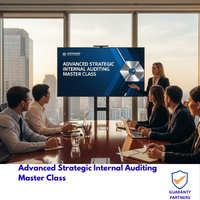
Advanced Strategic Internal Auditing Master Class
Course Overview
This Advanced Level course is four days, and is designed to help participants get a full understanding of Strategic Internal Auditing and the role and impact of the internal audit function.
Learning outcomes for participants of this Advanced Strategic Internal Auditing course:
• To focus on critical enterprise risks and emerging risks from the audit function side
• To contribute effectively to addressing ongoing Organisational business management risks on an outlier basis
• To ensure that risk reporting is linked to the Organisation’s business objectives
• To use effectively risk reporting in order to advance dialogues around risk appetite
• To integrate risk reporting with performance reporting
• To assess and report on whether changes in the external environment affect the critical assumptions underlying the Organisation’s strategy
Training Format:In-class, Virtual, In-house
Location:Lagos, Accra, Nairobi, Kigali
Language:English, French
Nigeria Price:
₦300000
Int'l., (Nigeria) Price:
$1000
Ghana Price:
$4000
Kenya Price:
$5500
Rwanda Price:
$6000
Nigeria Price:₦300000
Int'l., (Nigeria) Price:
$1000
Ghana Price:
$4000
Kenya Price:
$4000
Rwanda Price:
$4000
Nigeria Price: ₦300000
Int'l., (Nigeria) Price:
$1000
Ghana Price: $4000
Kenya Price: $4000
Rwanda Price: $4000
Review of Key Audit Function Foundations
• Review of key action points
• Developing organizational specific risk matrices
• Global best practice – case studies & analysis
• Key action points – Delegate action plan development
Risk Based Auditing
• Identifying areas of risk
• Classifying and quantifying risk areas
• Developing audit and re-audit frequency in line with risk
• Overview of emerging threats
Review of Key Audit Function Foundations
• Review of key action points
• Develop organisational specific risk matrices
• Global best practice – case studies – lessons learned analysis
• Key action points – delegate and manage action plan development
Risk – Based Auditing
• Identifying areas of risk
• Identifying new areas of risk
• Classification and quantification of risk areas
• Identifying potential interface of existing and new areas of risk
• Developing audit and re – audit frequency in alignment with risk
• Overview of emerging and evolving threats
Conducting Effective Audits
• The auditor’s role as a consultant
• Utilising audit reporting to inform organisational policy development
• Continuous improvement initiatives and supervision
• Measuring improvement – toolkit for objective measurement and demonstration of audit output improvements
Financial crime compliance
• Record keeping procedures
• Controls to identify potentially suspicious activities
• Trade finance transactions
• Trade processing controls by processing staff
• Red flagging procedures
• Pre-determined thresholds systems and controls
• Escalations
• Actions taken by senior management
• Evidence and awareness of senior management evidencing how crime risks evolve in organisational type of business
Engaging with the Audit Structure
• Making effective recommendations and business cases
• Presenting information effectively
• OSCOLA (Oxford University Standard for the Citation of Legal Authorities) for internal auditors
• Contributing meaningfully to the development of the long – term audit strategy
• Upgrading the profile of internal audit within the organisation
Audit reports – Working with Stakeholders
• Effective post audit de-briefing
• Root cause analysis and remediation recommendations
• Developing departmental action plans with stakeholders: contributing to the delivery of compliance 2.0
• Managing conflict situations
FOR WHOM:
All Internal Auditors in both the Public and Private Sectors.
1ST BATCH: Tuesday, February 3, 2026 — Friday, February 6, 2026.
2ND BATCH: Tuesday, May 26, 2026 — Friday, May 29, 2026.
3RD BATCH: Tuesday, September 22, 2026 — Friday, September 25, 2026.
The training methodology integrates lectures, interactive discussions, collaborative group exercises, and
illustrative examples. Participants will acquire a blend of theoretical insights and hands-on practical
experience, emphasizing the application of learned techniques. This approach ensures that attendees return
to their professional environments equipped with both the competence and self-assurance to effectively
implement the acquired skills in their responsibilities.