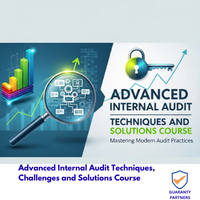
Advanced Internal Audit Techniques, Challenges and Solutions Course

Course Overview

• Identify the best practices for selling audit results to stakeholders.
• Demonstrate the steps necessary to wrap up the audit after the report is issued.
• Conduct the follow-up and validation of resolutions to audit recommendations.
• Recognize the formal quality assurance standards that the internal audit function is required to follow.
• Identify the core elements of the International Professional Practices Framework (IPPF).
• Describe the components of the audit model.
• Identify the components of the COSO Internal Control Framework.
• Identify the requirements of annual audit planning.
• Compare the roles and responsibilities for governance including that of internal auditors.
• Identify the components of interviews and how interviewing is used within an audit.
• Describe best practices for conducting and documenting interviews.
• Identify the common forms used during process documentation.
• Identify risks and key controls during the risk assessment process.
• Apply the methods for obtaining and presenting audit evidence.

Training Format:In-class, Virtual, In-house

Location:Lagos, Accra, Nairobi, Kigali

Language:English, French

Nigeria Price:
₦300000

Int'l., (Nigeria) Price:
$1000

Ghana Price:
$4000

Kenya Price:
$5500

Rwanda Price:
$6000

Nigeria Price:₦300000

Int'l., (Nigeria) Price:
$1000

Ghana Price:
$4000

Kenya Price:
$4000

Rwanda Price:
$4000

Nigeria Price: ₦300000

Int'l., (Nigeria) Price:
$1000

Ghana Price: $4000

Kenya Price: $4000

Rwanda Price: $4000

Understanding the Control Environment
• COSO Internal Control Framework
• SOX overview
• Enterprise risk management (ERM)
• COSO ERM Framework
• Commonly used internal control resources
• Definitions of risk and risk management

The International Professional Practices Framework (IPPF)
• Overview of the new IPPF
• Mandatory guidance
• Applying the Code of Ethics
• Overview of the audit model

Audit Governance
• IIA guidance on governance
• The board, audit committee, and CAE
• Executive management and management-level committees
• Internal audit, external audit, other assurance providers, and regulators

Audit Planning & Opening Conference
• Preliminary audit planning
• Your role in audit planning
• Conducting an interview
• Types of interviews and best practices for conducting interviews
• Interview practices to avoid
• Best practices for documenting interviews
• Defining audit scope and objectives, hours, resources, and key activities
• Preparing and submitting an audit planning memo
• Reviewing existing internal control documentation and assurance work
• Reviewing policies and procedures applicable to the function
• Reviewing and creating process flow documentation
• Best practices for narratives and flowcharts
• Conducting an effective audit opening conference

Roles and Responsibilities
• Roles of internal auditors
• Internal audit customers and stakeholders
• Audit team roles
• Definition of integrated auditing
• Qualifications of audit team members, by level
• Mission statement, vision statement, and audit charter
• Sample internal audit organizational charts, job descriptions, audit charters, etc.
1ST BATCH: Tuesday, February 3, 2026 — Friday, February 6, 2026.

2ND BATCH: Tuesday, May 26, 2026 — Friday, May 29, 2026.

3RD BATCH: Tuesday, September 22, 2026 — Friday, September 25, 2026.

The training methodology integrates lectures, interactive discussions, collaborative group exercises, and
illustrative examples. Participants will acquire a blend of theoretical insights and hands-on practical
experience, emphasizing the application of learned techniques. This approach ensures that attendees return
to their professional environments equipped with both the competence and self-assurance to effectively
implement the acquired skills in their responsibilities.

Facebook
WhatsApp
X
Threads
Telegram
Print