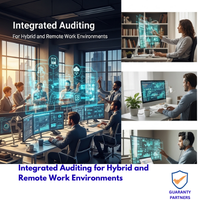
Integrated Auditing for Hybrid and Remote Work Environments
Course Overview
- To understand the role of integrated auditing in the context of hybrid and remote work environments.
- To identify the unique challenges of auditing in these settings and develop effective strategies.
- To explore tools, techniques, and best practices for ensuring compliance and security in hybrid and remote workplaces.
- To enhance the ability to assess risks and implement controls in virtual environments.
Training Format:In-class, Virtual, In-house
Location:Lagos, Accra, Nairobi, Kigali
Language:English, French
Nigeria Price:
₦300000
Int'l., (Nigeria) Price:
$1000
Ghana Price:
$4000
Kenya Price:
$5500
Rwanda Price:
$6000
Nigeria Price:₦300000
Int'l., (Nigeria) Price:
$1000
Ghana Price:
$4000
Kenya Price:
$4000
Rwanda Price:
$4000
Nigeria Price: ₦300000
Int'l., (Nigeria) Price:
$1000
Ghana Price: $4000
Kenya Price: $4000
Rwanda Price: $4000
Introduction to Hybrid and Remote Work Auditing
- Overview of Hybrid and Remote Work Models
- Definition and key differences between hybrid, remote, and traditional work settings.
- Emerging trends and impacts on auditing practices.
- Introduction to Integrated Auditing
- What is integrated auditing?
- Key concepts: IT audit, internal controls, risk management, and compliance.
- Auditing Challenges in Hybrid and Remote Environments
- Communication barriers, technology gaps, and dispersed teams.
- Identifying and managing audit risks in a decentralized workforce.
Auditing Tools and Techniques for Remote Environments
- Audit Tools for Remote Work
- Digital collaboration platforms, cloud-based tools, and virtual meetings.
- Security monitoring tools and compliance management software.
- Techniques for Remote Data Collection
- Virtual interviews, surveys, and evidence gathering.
- Remote testing and system access controls.
- Ensuring Data Security and Privacy in Remote Work
- Key risks: data breaches, unauthorized access, and data integrity issues.
- Auditing cybersecurity measures in hybrid and remote environments.
Risk Management and Compliance in Hybrid Work Environments
- Risk Assessment in Remote Work
- Identifying operational, financial, and compliance risks in virtual settings.
- Adapting risk management frameworks for remote teams.
- Internal Controls for Remote Work
- Evaluating controls for virtual work processes.
- Implementing access controls, monitoring, and segregation of duties remotely.
- Compliance Issues and Regulatory Considerations
- Ensuring compliance with local and international regulations in remote environments.
- GDPR, HIPAA, and other privacy laws related to remote work.
Case Studies and Best Practices in Hybrid Work Auditing
- Case Study Analysis
- Real-life examples of successful audits in hybrid and remote environments.
- Lessons learned from challenges and failures in remote audits.
- Best Practices for Effective Auditing in Hybrid Work
- Building trust with remote teams.
- Continuous monitoring and audit adaptation in changing environments.
- Future Trends in Auditing for Hybrid and Remote Work
- Innovations in audit technology and the evolving role of auditors.
- Preparing for the future of work: automation, AI, and remote work auditing.
1ST BATCH: Tuesday, February 17, 2026 — Friday, February 20, 2026.
2ND BATCH: Tuesday, June 9, 2026 — Friday, June 12, 2026.
3RD BATCH: Tuesday, October 6, 2026 — Friday, October 9, 2026.
The training methodology integrates lectures, interactive discussions, collaborative group exercises, and
illustrative examples. Participants will acquire a blend of theoretical insights and hands-on practical
experience, emphasizing the application of learned techniques. This approach ensures that attendees return
to their professional environments equipped with both the competence and self-assurance to effectively
implement the acquired skills in their responsibilities.