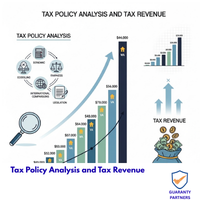
Tax Policy Analysis and Tax Revenue
Course Overview
Upon finishing this Tax Policy Analysis and Tax Revenue course successfully, participants will be able to:
• Describe the role of tax policy and revenue forecasting in the budget-making process.
• Identify good practices relating to the institutional framework that supports the tax policy and revenue forecasting process.
• Identify data requirements for each method of tax policy and revenue forecasting.
• Apply macro-based models for tax policy and forecasting tax revenue.
• Apply input-output models and microsimulation techniques to analyse tax policy and the distributional implications from indirect and direct taxes.
• Recognise the strengths and limitations of different models.
Training Format:In-class, Virtual, In-house
Location:Lagos, Accra, Nairobi, Kigali
Language:English, French
Nigeria Price:
₦300000
Int'l., (Nigeria) Price:
$1000
Ghana Price:
$4000
Kenya Price:
$5500
Rwanda Price:
$6000
Nigeria Price:₦300000
Int'l., (Nigeria) Price:
$1000
Ghana Price:
$4000
Kenya Price:
$4000
Rwanda Price:
$4000
Nigeria Price: ₦300000
Int'l., (Nigeria) Price:
$1000
Ghana Price: $4000
Kenya Price: $4000
Rwanda Price: $4000
TAX ANALYSIS
• Principles of taxation and tax reform
• The economic impact of taxes and subsidies
• Consumption TAX and expenditure taxes
• Taxes on international trade
• Taxation of income
• International tax harmonisation
DIFFERENT TYPES OF TAX POLICIES
• Wealth and asset taxation
• Property and real estate taxes
• Taxation of natural resources
• Taxation of financial sectors
• Inflation and taxation
• Taxation of e-commerce
• Taxation of MNCs and BEPS
TAX ADMINISTRATION & COMPLIANCE
• Tax administration and tax compliance
• Tax reform and implementation challenges
• Fiscal policy and fiscal architecture
• Natural resource taxation
• Tax incidence analysis
• Learning about taxes through experiments
• Natural resource taxation
• Tax incidence analysis
• Learning about taxes through experiments
REVENUE FORECASTING
• Value-added and excise taxes
• Trade taxes
• Personal income taxes
• Corporate income taxes
• Taxes on natural resources
• Property taxes
COMPUTER APPLICATIONS
• Introduction to computers and computerisation
• The impact of technology
• Microcomputers in revenue forecasting
• Cloud computing technology
• Private cloud computing system
• The power of collaboration
• Challenges
o Integration
o Performance
o Security
EMPIRICAL TECHNIQUES AND MODELS
• Micro-simulation models
• Typical taxpayer model
• Macroeconomic models
• GDP-based forecasting models
• Regression analysis
• Sampling techniques
• Consumer expenditure surveys
• Receipts model
RISK MANAGEMENT, COMPETITION & INCENTIVES
• Risk management of tax compliance
• Transfer pricing and international dispute resolution
• Tax competition and investment incentives
• Outline of tax agreements for double tax avoidance
1ST BATCH: Tuesday, January 27, 2026 — Friday, January 30, 2026.
2ND BATCH: Tuesday, May 19, 2026 — Friday, May 22, 2026.
3RD BATCH: Tuesday, September 15, 2026 — Friday, September 18, 2026.
The training methodology integrates lectures, interactive discussions, collaborative group exercises, and
illustrative examples. Participants will acquire a blend of theoretical insights and hands-on practical
experience, emphasizing the application of learned techniques. This approach ensures that attendees return
to their professional environments equipped with both the competence and self-assurance to effectively
implement the acquired skills in their responsibilities.