
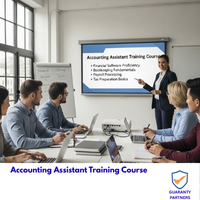
Accounting Assistant Training Course
Course Overview
The objective of this training is to provide you with up to date knowledge and practical skills in applying the basic concepts and principles of accounting in preparing financial statements
By the end of this training you will learn to:
• Develop an understanding of the basic concepts and principles of Accounting under Double-entry system
• Understand the meaning and significance of accounting
• Apply the qualitative characteristics that will help to develop the skill in the course of time to prepare financial statements
• Apply the rules of Debit and Credit under the Traditional approach and Accounting equation approach
• Practise how to record financial transactions and report them in financial statements
Training Format:In-class, Virtual, In-house
Location:Lagos, Accra, Nairobi, Kigali
Language:English, French
Nigeria Price:
₦300000
Int'l., (Nigeria) Price:
$1000
Ghana Price:
$4000
Kenya Price:
$5500
Rwanda Price:
$6000
Nigeria Price:₦300000
Int'l., (Nigeria) Price:
$1000
Ghana Price:
$4000
Kenya Price:
$4000
Rwanda Price:
$4000
Nigeria Price: ₦300000
Int'l., (Nigeria) Price:
$1000
Ghana Price: $4000
Kenya Price: $4000
Rwanda Price: $4000
Theoretical Framework
• Meaning and Scope of accounting
• Accounting Concepts, Principles and Conventions
• Accounting terminology – Glossary
• Capital and revenue expenditure, Capital and revenue receipts, Contingent assets and contingent liabilities
• Accounting Policies
Basic Accounting Process
• Double Entry System
• Advantages of Double Entry System
• Rules of Debit and Credit
• Accounting Equation Approach
• Traditional Approach
• Modern Classification of Accounts
• Recording transactions in Journal
Recording Transactions in Subsidiary Books
• The distinction between Subsidiary Books and Principal books
• Purchases Book
• Sales Book
• Sales Returns Book or Returns Inward Book
• Purchase Returns or Returns Outward Book
• Cash Books
• Importance of Journal
Ledgers
• Introduction to Ledger
• Specimen of Ledger Accounts Posting
• Balancing an Account
Closing the Accounts
• Bank Reconciliation Statement
• Recording depreciation for Fixed Assets
• Valuing the inventories
• Recording outstanding expenses
• Recording provision for doubtful debts
Preparation of Trial Balance
• Objectives of Preparing the Trial Balance
• Limitations of Trial Balance
• Methods of Preparation of Trial Balance
• Adjusted Trial Balance (Through Suspense Account)
• Rules of Preparing the Trial Balance
Preparation of Financial Statements
• Five Elements of Financial Statements (Equity, Income, Expense, Assets & Liabilities)
• The objective of Financial Statements
• Primary Financial Statements
• Statement of Financial Position or Balance Sheet
• Statement of Profit or Loss
• Statement of Cash Flows
• Statement of Changes in Equity
• Notes to Financial Statements
Accounting in Digital Environment
• Salient Features of Digital Accounting
• Codification and Grouping of Accounts
• Maintaining the hierarchy of ledgers
• Accounting Software
• Enterprise Resource Planning (ERP) by using the Accounting Software
1ST BATCH: Tuesday, February 3, 2026 — Friday, February 6, 2026.
2ND BATCH: Tuesday, May 26, 2026 — Friday, May 29, 2026.
3RD BATCH: Tuesday, September 22, 2026 — Friday, September 25, 2026.
The training methodology integrates lectures, interactive discussions, collaborative group exercises, and
illustrative examples. Participants will acquire a blend of theoretical insights and hands-on practical
experience, emphasizing the application of learned techniques. This approach ensures that attendees return
to their professional environments equipped with both the competence and self-assurance to effectively
implement the acquired skills in their responsibilities.