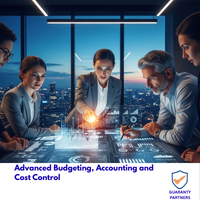
Advanced Budgeting, Accounting and Cost Control
Course Overview
• Refine costing and budgeting terminology used in business
• Understand the importance of a well-defined costing and budgeting process
• Determine full costs of outputs for the goods and services provided
• Master traditional techniques and recent best practices on budgeting / cost control
• Link finance and operation for budgeting purposes and strategy execution
• Learn how to build a comprehensive performance measurement system
Training Format:In-class, Virtual, In-house
Location:Lagos, Accra, Nairobi, Kigali
Language:English, French
Nigeria Price:
₦30000
Int'l., (Nigeria) Price:
$1000
Ghana Price:
$4000
Kenya Price:
$5500
Rwanda Price:
$6000
Nigeria Price:₦30000
Int'l., (Nigeria) Price:
$1000
Ghana Price:
$4000
Kenya Price:
$4000
Rwanda Price:
$4000
Nigeria Price: ₦30000
Int'l., (Nigeria) Price:
$1000
Ghana Price: $4000
Kenya Price: $4000
Rwanda Price: $4000
Introduction: The Relevance of Budgeting and Cost control within Strategy Execution
• The Link between Strategy, Planning, Budgeting and Cost control
• Why Budgeting and Costing are so important to manage your company?
• Towards a Cross-functional Process-view of the Organization
• Financial vs. Managerial Accounting (where you get information for decision-making)
• Understand your Processes: Integrating Financial and Non-financial Aspects
• Identify and Discuss the Key issues in terms of Budget / Costing for your own Organization
• Discussion
The Budgeting Framework and its Role within the Management Process
• The Role of Budgeting within Management Accounting
• The Value of Budgeting in your Company
• Behavioral Implications of Budgeting
• Key Concepts and Terminology
• Advantages and Disadvantages: Critical issues to be Discussed
• Overview on the Financial Statements – Balance sheet, Income statement and Cash-Flow
• Case Discussion and Examples
Cost Management for Budgeting Purposes
• Cost Concepts and Terminology
• Different Costs for Different Purposes
• Fixed vs. Variable Costs: The Cost-Volume-Profit Analysis Model
• Contribution Margin Analysis
• Manufacturing vs. Non-manufacturing Costs
• Period vs. Product Costs: Inventory Evaluation and Control
• Case Study and Discussions
Case Study – Traditional vs. Advanced Techniques in Cost-control
• Under-costing and Over-costing: the Consequences for Profitability
• How to refine a Costing System?
• Indirect vs. Direct costs: Traditional Cost Allocations Systems vs. Activity-Based Costing
• Cost Drivers: Linking Resources, Activities and Management
• Introducing Activity-Based Budgeting (ABB) and Management (ABM)
• Case Study Analysis
• Examples and Videos
Broadening the Performance Measurement Systems
• Shortcomings of Traditional Approaches to Budgeting and Performance Measurement
• Need to Linking Financial to Operational Issues
• Recent Best Practices: the Balanced Scorecard and Six-sigma
• Financial Perspective and Customer Perspective
• Internal Business Process Perspective and Learning & Growth Perspective
• Developing and Adapting the Scorecard
• Video, Case Study Illustration and Discussion
FOR WHOM:
Accountants, Auditors, Financial Controllers, Admin Managers, Planning Managers, Finance Managers and Financial Analysts, CFOs and others who perform related functions in both public and private sectors.
1ST BATCH: Tuesday, March 10, 2026 — Friday, February 13, 2026.
2ND BATCH: Tuesday, June 30, 2026 — Friday, July 3, 2026.
3RD BATCH: Tuesday, October 27, 2026 — Friday, October 30, 2026.
The training methodology integrates lectures, interactive discussions, collaborative group exercises, and
illustrative examples. Participants will acquire a blend of theoretical insights and hands-on practical
experience, emphasizing the application of learned techniques. This approach ensures that attendees return
to their professional environments equipped with both the competence and self-assurance to effectively
implement the acquired skills in their responsibilities.