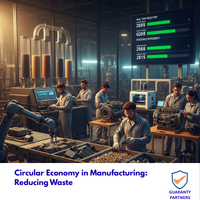
Circular Economy in Manufacturing: Reducing Waste

Course Overview

  • Understand the principles of circular economy and its importance in manufacturing.
  • Learn how to design for sustainability and reduce waste in manufacturing processes.
  • Explore strategies for recycling and reusing materials in manufacturing operations.
  • Implement best practices for waste management and resource efficiency in manufacturing.

Training Format:In-class, Virtual, In-house

Location:Lagos, Accra, Nairobi, Kigali

Language:English, French

Nigeria Price:
₦430000

Int'l., (Nigeria) Price:
$1000

Ghana Price:
$5000

Kenya Price:
$6500

Rwanda Price:
$7000

Nigeria Price:₦430000

Int'l., (Nigeria) Price:
$1000

Ghana Price:
$5000

Kenya Price:
$5000

Rwanda Price:
$5000

Nigeria Price: ₦430000

Int'l., (Nigeria) Price:
$1000

Ghana Price: $5000

Kenya Price: $5000

Rwanda Price: $5000

Circular Economy Principles and Manufacturing

  • Introduction to circular economy concepts
  • The role of circular economy in sustainability
  • Economic, environmental, and social benefits of circular economy
  • Transitioning from linear to circular models in manufacturing
  • Key challenges and opportunities for manufacturers in adopting circular economy practices

Designing for Sustainability in Manufacturing

  • Eco-design principles and their role in reducing waste
  • Sustainable product life cycles and materials selection
  • Design for disassembly and recyclability
  • Product design innovations to minimize environmental impact
  • Collaboration with suppliers for sustainable sourcing

Recycling and Reusing Materials in Manufacturing

  • Waste hierarchy: reduce, reuse, recycle
  • Types of recyclable materials in manufacturing
  • Closed-loop systems for material reuse

1ST BATCH: Tuesday, April 27, 2027 — Friday, April 30, 2027.

2ND BATCH: Tuesday, August 17, 2027 — Friday, August 20, 2027.

3RD BATCH: Tuesday, December 7, 2027 — Friday, December 10, 2027.

The training methodology integrates lectures, interactive discussions, collaborative group exercises, and
illustrative examples. Participants will acquire a blend of theoretical insights and hands-on practical
experience, emphasizing the application of learned techniques. This approach ensures that attendees return
to their professional environments equipped with both the competence and self-assurance to effectively
implement the acquired skills in their responsibilities.

Facebook
WhatsApp
X
Threads
Telegram
Print