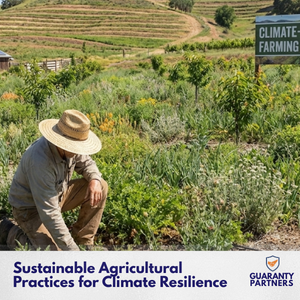
Sustainable Agricultural Practices for Climate Resilience
Course Overview
• Understand the relationship between climate change and agricultural systems.
• Learn sustainable agricultural practices that enhance climate resilience.
• Explore techniques for improving soil health and water management.
• Understand the role of agroforestry and biodiversity in climate adaptation.
Training Format:In-class, Virtual, In-house
Location:Lagos, Accra, Nairobi, Kigali
Language:English, French
Nigeria Price:
₦350000
Int'l., (Nigeria) Price:
$1000
Ghana Price:
$4000
Kenya Price:
$5500
Rwanda Price:
$6000
Nigeria Price:₦350000
Int'l., (Nigeria) Price:
$1000
Ghana Price:
$4000
Kenya Price:
$4000
Rwanda Price:
$4000
Nigeria Price: ₦350000
Int'l., (Nigeria) Price:
$1000
Ghana Price: $4000
Kenya Price: $4000
Rwanda Price: $4000
Introduction to Climate Change and Agriculture
• Overview of climate change impacts on agriculture.
• Effects of changing weather patterns on crop yields and livestock.
• Vulnerabilities in different agricultural systems.
• Importance of climate resilience in farming practices.
Sustainable Soil Management for Climate Resilience
• Importance of soil health for climate adaptation.
• Practices like crop rotation, reduced tillage, and cover cropping.
• Organic amendments and composting.
• Techniques for erosion control and improving soil fertility.
Water Management and Conservation in Agriculture
• Efficient irrigation systems and technologies.
• Rainwater harvesting techniques.
• Mulching and its benefits for water retention.
• Water-use efficiency practices for different crops.
Agroforestry and Biodiversity for Climate Adaptation
• Role of trees and agroforestry systems in climate resilience.
• Integrating trees with crops and livestock for improved biodiversity.
• Benefits of diverse farming systems in mitigating climate change impacts.
• Conservation practices for protecting biodiversity on farms.

1ST BATCH: Tuesday, January 13, 2026 — Friday, January 16, 2026.
2ND BATCH: Tuesday, May 5, 2026 — Friday, May 8, 2026.
3RD BATCH: Tuesday, September 1, 2026 — Friday, September 4, 2026.
The training methodology integrates lectures, interactive discussions, collaborative group exercises, and
illustrative examples. Participants will acquire a blend of theoretical insights and hands-on practical
experience, emphasizing the application of learned techniques. This approach ensures that attendees return
to their professional environments equipped with both the competence and self-assurance to effectively
implement the acquired skills in their responsibilities.