
Shipping and Port Management Complete Course
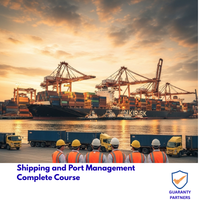
Course Overview
On completion of this shipping and port management course, participants will be able to:
• Examine the latest developments, knowledge and practices taking place within the shipping and port industry
• Define maritime logistics value and its strategic significance
• Provide a global perspective on the increasingly key area of logistics
• Understand all the aspects of logistics including container shipping, dry and wet bulk shipping, and port-centric logistics
• Define logistics hub and its applications for container ports and improve Supply chain accessibility and efficiency
Training Format:In-class, Virtual, In-house
Location:Lagos, Accra, Nairobi, Kigali
Language:English, French
Nigeria Price:
₦3000000
Int'l., (Nigeria) Price:
$1000
Ghana Price:
$4000
Kenya Price:
$5500
Rwanda Price:
$6000
Nigeria Price:₦3000000
Int'l., (Nigeria) Price:
$1000
Ghana Price:
$4000
Kenya Price:
$4000
Rwanda Price:
$4000
Nigeria Price: ₦3000000
Int'l., (Nigeria) Price:
$1000
Ghana Price: $4000
Kenya Price: $4000
Rwanda Price: $4000
Defining Maritime Logistics and Its Value
Maritime logistics in concept
Maritime logistics value defined
Strategic significance of maritime logistics value
Concluding remarks
International Maritime Trade and Logistics
Logistics and supply chain management
Logistics and transport
Global trade and international maritime trade
Global trade and international trade
Intermodal Freight Transport and Logistics
Characteristics of intermodal transport
Containerisation of intermodal transport
Advantages of intermodal transport
Containerisation and intermodal transport
Development of intermodal transport
Combined transport operators and their services
Towards innovative intermodal transport
Developing Liner Service Networks in Container Shipping
Background on container shipping
Configuration and design of liner shipping services
Shipping routes, network patterns and port centrality
Tanker Shipping Logistics
Transfer components
Marine terminals
Contractual relationships
Cargo transfer procedures
Cargo losses
Defining Logistics Hub and Its Applications for Container Ports
Logistics hub in perspective
Application of logistics hub to container port
Economics and social network theories for container hub port evolution
Hinterland Logistics and Global Supply Chains
Supply chain accessibility and efficiency
System design
Strategy
Management
Hinterland logistics and its influence on global supply chains
Logistics Performance of Supply Chain-Oriented Ports
Review of relevant literature
Evolution of port research
Supply chains and seaports
Integration of ports in supply chains
Research model and data collection
Empirical analysis and results
1ST BATCH: Tuesday, February 24, 2026 — Friday, February 27, 2026.
2ND BATCH: Tuesday, June 16, 2026 — Friday, June 19, 2026.
3RD BATCH: Tuesday, October 13, 2026 — Friday, October 16, 2026.
The training methodology integrates lectures, interactive discussions, collaborative group exercises, and
illustrative examples. Participants will acquire a blend of theoretical insights and hands-on practical
experience, emphasizing the application of learned techniques. This approach ensures that attendees return
to their professional environments equipped with both the competence and self-assurance to effectively
implement the acquired skills in their responsibilities.