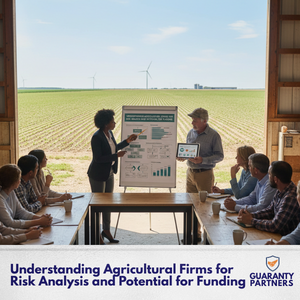
Understanding Agricultural Firms for Risk Analysis and Potential for Funding
Course Overview
By the end of this course, participants will be able to:
• Understand the structure, operations, and challenges of agricultural firms.
• Identify key risks associated with agricultural enterprises.
• Analyze financial and operational data to evaluate agricultural firms’ viability.
• Develop frameworks for assessing funding potential and mitigating risks.
• Recommend sustainable financing options tailored to agricultural businesses.
Training Format:In-class, Virtual, In-house
Location:Lagos, Accra, Nairobi, Kigali
Language:English, French
Nigeria Price:
₦350000
Int'l., (Nigeria) Price:
$1000
Ghana Price:
$4000
Kenya Price:
$5500
Rwanda Price:
$6000
Nigeria Price:₦350000
Int'l., (Nigeria) Price:
$1000
Ghana Price:
$4000
Kenya Price:
$4000
Rwanda Price:
$4000
Nigeria Price: ₦350000
Int'l., (Nigeria) Price:
$1000
Ghana Price: $4000
Kenya Price: $4000
Rwanda Price: $4000
Introduction to Agricultural Firms
• Overview of the agricultural industry.
• Types of agricultural firms (smallholder farms, agribusinesses, cooperatives).
• Key value chains in agriculture (crop production, livestock, fisheries, agro-processing).
• Role of agricultural firms in economic development.
Risk Analysis in Agricultural Firms
• Types of risks in agriculture:
o Environmental and climate risks.
o Market and price volatility risks.
o Operational and production risks.
o Financial and credit risks.
• Tools for risk assessment in agriculture.
• Case studies on risk management strategies.
Financial Analysis of Agricultural Firms
• Understanding agricultural cash flows and financial cycles.
• Key financial metrics for evaluating agricultural firms.
• Assessing the profitability and sustainability of agricultural businesses.
• Challenges in financial reporting for agricultural firms.
Assessing the Funding Potential of Agricultural Firms
• Criteria for funding agricultural businesses.
• Factors influencing investment decisions in agriculture.
• Impact of technology and innovation on funding potential.
• Role of government and international organizations in agricultural funding.
Financing Options for Agricultural Firms
• Types of financing for agriculture:
o Debt financing.
o Equity financing.
o Grants and subsidies.
o Innovative financing models (e.g., crowdfunding, green bonds).
• Designing funding solutions tailored to agricultural firms.
• Risk-sharing mechanisms between lenders and agricultural firms.
1ST BATCH: Tuesday, February 3, 2026 — Friday, February 6, 2026.
2ND BATCH: Tuesday, May 26, 2026 — Friday, May 29, 2026.
3RD BATCH: Tuesday, September 22, 2026 — Friday, September 25, 2026.
The training methodology integrates lectures, interactive discussions, collaborative group exercises, and
illustrative examples. Participants will acquire a blend of theoretical insights and hands-on practical
experience, emphasizing the application of learned techniques. This approach ensures that attendees return
to their professional environments equipped with both the competence and self-assurance to effectively
implement the acquired skills in their responsibilities.