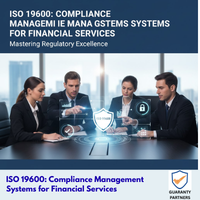
ISO 19600: Compliance Management Systems for Financial Services
Course Overview
By the end of this course, participants will be able to:
• Understand the principles and framework of ISO 19600: Compliance Management Systems.
• Develop, implement, and maintain an effective compliance management system within financial services.
• Identify and address compliance risks in financial operations, leveraging the ISO 19600 standard.
• compliance management with organizational strategies and operational processes.
• Foster a culture of compliance within the financial services sector.
• Evaluate and monitor the effectiveness of compliance systems using ISO 19600 guidelines.
• Adapt the compliance framework to align with other standards such as ISO 37001 (Anti-Bribery) and ISO 31000 (Risk Management).
Training Format:In-class, Virtual, In-house
Location:Lagos, Accra, Nairobi, Kigali
Language:English, French
Nigeria Price:
₦330000
Int'l., (Nigeria) Price:
$1000
Ghana Price:
$4000
Kenya Price:
$5500
Rwanda Price:
$6000
Nigeria Price:₦330000
Int'l., (Nigeria) Price:
$1000
Ghana Price:
$4000
Kenya Price:
$4000
Rwanda Price:
$4000
Nigeria Price: ₦330000
Int'l., (Nigeria) Price:
$1000
Ghana Price: $4000
Kenya Price: $4000
Rwanda Price: $4000
Introduction to ISO 19600
o Overview of ISO 19600 and its importance in financial services.
o Key definitions and terminology.
o Benefits of adopting a Compliance Management System (CMS).
Principles of Compliance Management
o Risk-based approach to compliance.
o Leadership and commitment to compliance.
o Organizational culture and integrity.
Framework for Compliance Management Systems
o Structure of ISO 19600.
o Understanding the context of the organization.
o Key roles and responsibilities in compliance management.
Compliance Risk Assessment in Financial Services
o Identifying compliance risks in financial institutions.
o Tools and techniques for risk assessment.
o Prioritizing risks based on impact and likelihood.
Developing a Compliance Management System
o Designing policies and procedures.
o Setting up compliance objectives and indicators.
o Allocating resources and defining responsibilities.
Implementing Compliance Management Systems
o Integrating compliance into daily operations.
o Training and awareness programs for employees.
o Communication and documentation processes.
Monitoring and Evaluation
o Compliance performance measurement and reporting.
o Internal audits and assessments.
o Addressing non-compliance and corrective actions.
1ST BATCH: Tuesday, January 13, 2026 — Friday, January 16, 2026.
2ND BATCH: Tuesday, May 5, 2026 — Friday, May 8, 2026.
3RD BATCH: Tuesday, September 1, 2026 — Friday, September 4, 2026.
The training methodology integrates lectures, interactive discussions, collaborative group exercises, and
illustrative examples. Participants will acquire a blend of theoretical insights and hands-on practical
experience, emphasizing the application of learned techniques. This approach ensures that attendees return
to their professional environments equipped with both the competence and self-assurance to effectively
implement the acquired skills in their responsibilities.