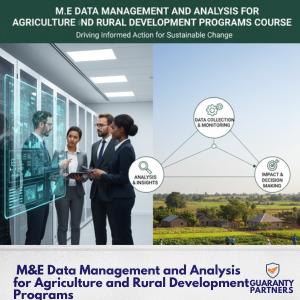
M&E Data Management and Analysis for Agriculture and Rural Development Programs
Course Overview
By the end of this training, participants will be able to:
• Understand the fundamental principles of Monitoring and Evaluation (M&E) in agriculture and rural development programs.
• Acquire skills in data collection, management, and analysis for effective decision-making.
• Develop and utilize tools for tracking progress and evaluating program outcomes.
• Apply statistical and data visualization techniques to communicate findings.
• Ensure data quality and integrity in M&E processes.
• Integrate modern technologies, including GIS and mobile data collection tools, for enhanced M&E practices.
• Align M&E frameworks with international agricultural development goals (e.g., SDGs).
Training Format:In-class, Virtual, In-house
Location:Lagos, Accra, Nairobi, Kigali
Language:English, French
Nigeria Price:
₦350000
Int'l., (Nigeria) Price:
$1000
Ghana Price:
$4000
Kenya Price:
$5500
Rwanda Price:
$6000
Nigeria Price:₦350000
Int'l., (Nigeria) Price:
$1000
Ghana Price:
$4000
Kenya Price:
$4000
Rwanda Price:
$4000
Nigeria Price: ₦350000
Int'l., (Nigeria) Price:
$1000
Ghana Price: $4000
Kenya Price: $4000
Rwanda Price: $4000
Introduction to M&E in Agriculture and Rural Development
• Importance of M&E in agricultural and rural development programs.
• Key concepts, principles, and frameworks of M&E.
• Setting up M&E systems for agricultural projects.
Data Collection and Management in Agricultural M&E
• Data collection methodologies: surveys, focus groups, and participatory approaches.
• Designing tools for data collection: questionnaires, mobile apps, and digital tools.
• Data storage and management techniques: databases and cloud systems.
Ensuring Data Quality in M&E
• Data cleaning, validation, and quality assurance processes.
• Addressing common challenges in agricultural data collection.
• Strategies to maintain data integrity and reliability.
Data Analysis for Agricultural and Rural Development Programs
• Statistical tools and software for M&E (e.g., SPSS, STATA, R).
• Descriptive and inferential statistical methods for agricultural data.
• Trend analysis and predictive modeling in agricultural development.
Visualization and Reporting of M&E Data
• Data visualization techniques using tools like Excel, Tableau, and Power BI.
• Creating dashboards for real-time monitoring.
• Developing clear and actionable M&E reports for stakeholders.
Use of Technology in M&E for Agriculture
• GIS applications in agricultural M&E.
• Mobile data collection tools (e.g., Kobo Toolbox, ODK).
• Remote sensing and drones in monitoring agricultural projects.
1ST BATCH: Tuesday, April 21, 2026 — Friday, April 24, 2026.
2ND BATCH: Tuesday, August 11, 2026 — Friday, August 14, 2026.
3RD BATCH: Tuesday, December 8, 2026 — Friday, December 11, 2026.
The training methodology integrates lectures, interactive discussions, collaborative group exercises, and
illustrative examples. Participants will acquire a blend of theoretical insights and hands-on practical
experience, emphasizing the application of learned techniques. This approach ensures that attendees return
to their professional environments equipped with both the competence and self-assurance to effectively
implement the acquired skills in their responsibilities.