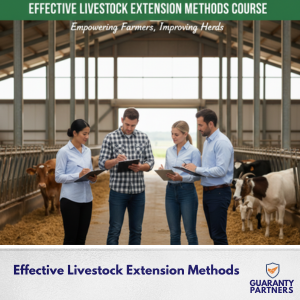
Effective Livestock Extension Methods

Course Overview

• Understand the role of livestock extension in improving productivity and sustainability.
• Explore different extension methods for effective communication and training.
• Learn how to tailor extension methods to different types of livestock farmers.
• Develop strategies for evaluating and improving livestock extension programs.

Training Format:In-class, Virtual, In-house

Location:Lagos, Accra, Nairobi, Kigali

Language:English, French

Nigeria Price:
₦350000

Int'l., (Nigeria) Price:
$1000

Ghana Price:
$4000

Kenya Price:
$5500

Rwanda Price:
$6000

Nigeria Price:₦350000

Int'l., (Nigeria) Price:
$1000

Ghana Price:
$4000

Kenya Price:
$4000

Rwanda Price:
$4000

Nigeria Price: ₦350000

Int'l., (Nigeria) Price:
$1000

Ghana Price: $4000

Kenya Price: $4000

Rwanda Price: $4000

Introduction to Livestock Extension
• Overview of livestock extension and its importance.
• Key roles and responsibilities of extension agents.
• The challenges in livestock farming and how extension addresses them.
• The extension process: needs assessment, planning, implementation, and evaluation.

Extension Methods and Approaches
• Traditional vs. modern extension methods.
• Group extension methods: workshops, field days, and demonstrations.
• One-on-one extension: farm visits, advisory services.
• Participatory extension: involving farmers in decision-making.
• Use of digital tools and social media in livestock extension.

Tailoring Extension Methods to Livestock Farmers
• Understanding different types of livestock farmers (smallholder vs. commercial).
• Adapting extension methods based on farm size, resources, and goals.
• Communication strategies for diverse farmer demographics (age, education, gender).
• Overcoming barriers to effective communication with farmers.

Monitoring and Evaluating Livestock Extension Programs
• Key performance indicators for livestock extension programs.
• Methods for monitoring and evaluating the effectiveness of extension services.
• Gathering feedback from farmers and stakeholders.
• Continuous improvement: adjusting methods based on evaluation outcomes.

1ST BATCH: Tuesday, April 14, 2026 — Friday, April 17, 2026.

2ND BATCH: Tuesday, August 4, 2026 — Friday, August 7, 2026.

3RD BATCH: Tuesday, December 1, 2026 — Friday, December 4, 2026.

The training methodology integrates lectures, interactive discussions, collaborative group exercises, and
illustrative examples. Participants will acquire a blend of theoretical insights and hands-on practical
experience, emphasizing the application of learned techniques. This approach ensures that attendees return
to their professional environments equipped with both the competence and self-assurance to effectively
implement the acquired skills in their responsibilities.

Facebook
WhatsApp
X
Threads
Telegram
Print