
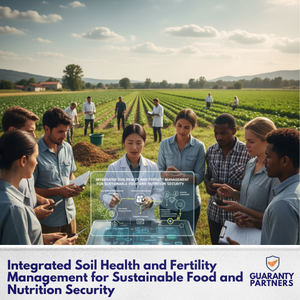
Integrated Soil Health and Fertility Management for Sustainable Food and Nutrition Security
Course Overview
By the end of this course, participants will be able to:
• Understand the principles and practices of integrated soil health and fertility management.
• Identify the relationship between soil health and sustainable food and nutrition security.
• Develop strategies to improve soil fertility using organic, inorganic, and biological inputs.
• Apply modern tools and technologies to assess soil health and fertility.
• Integrate soil management practices into sustainable agricultural systems.
• Evaluate the impact of soil health interventions on crop productivity and nutrition.
• Design and implement site-specific soil fertility management plans.
Training Format:In-class, Virtual, In-house
Location:Lagos, Accra, Nairobi, Kigali
Language:English, French
Nigeria Price:
₦350000
Int'l., (Nigeria) Price:
$1000
Ghana Price:
$4000
Kenya Price:
$5500
Rwanda Price:
$6000
Nigeria Price:₦350000
Int'l., (Nigeria) Price:
$1000
Ghana Price:
$4000
Kenya Price:
$4000
Rwanda Price:
$4000
Nigeria Price: ₦350000
Int'l., (Nigeria) Price:
$1000
Ghana Price: $4000
Kenya Price: $4000
Rwanda Price: $4000
Introduction to Soil Health and Fertility Management
• Definition and importance of soil health in agriculture.
• Key indicators of soil health: physical, chemical, and biological properties.
• The role of soil fertility in achieving food and nutrition security.
• Challenges in maintaining soil health in different agro-ecosystems.
Soil Nutrient Dynamics and Management
• Essential plant nutrients and their functions in soil systems.
• Soil nutrient cycles (nitrogen, phosphorus, potassium, etc.).
• Common nutrient deficiencies and toxicity in crops.
• Soil testing and interpretation of results for fertility recommendations.
Integrated Soil Fertility Management (ISFM)
• Principles and components of ISFM.
• Combining organic inputs (manure, compost) with inorganic fertilizers.
• Use of biofertilizers and soil amendments to enhance fertility.
• Site-specific nutrient management strategies.
Soil Health Improvement Techniques
• Conservation agriculture and its impact on soil health.
• Cover crops, crop rotation, and intercropping for soil fertility.
• Agroforestry systems and their role in improving soil health.
• Techniques for erosion control and soil structure improvement.
Tools and Technologies for Soil Health Monitoring
• Digital tools for soil health assessment (GIS, remote sensing, etc.).
• Laboratory and field-based soil testing equipment.
• Precision agriculture technologies for fertility management.
Policy and Economic Perspectives
• Policies and programs supporting sustainable soil management.
• Economics of soil health improvement practices.
• Public-private partnerships for promoting sustainable soil management.
1ST BATCH: Tuesday, February 3, 2026 — Friday, February 6, 2026.
2ND BATCH: Tuesday, May 26, 2026 — Friday, May 22, 2026.
3RD BATCH: Tuesday, September 22, 2026 — Friday, September 25, 2026.
The training methodology integrates lectures, interactive discussions, collaborative group exercises, and
illustrative examples. Participants will acquire a blend of theoretical insights and hands-on practical
experience, emphasizing the application of learned techniques. This approach ensures that attendees return
to their professional environments equipped with both the competence and self-assurance to effectively
implement the acquired skills in their responsibilities.