
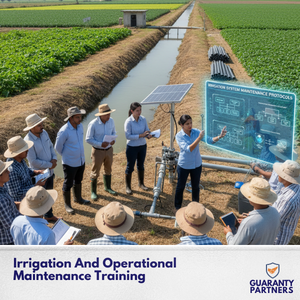
Irrigation And Operational Maintenance Training
Course Overview
By the end of this training, participants will be able to:
• Understand the principles and components of irrigation systems.
• Perform proper maintenance practices to ensure efficient operation of irrigation systems.
• Troubleshoot and repair common issues with irrigation systems.
• Understand irrigation scheduling and its importance in crop production.
• Learn how to manage water resources efficiently in irrigation systems.
• Improve the longevity and efficiency of irrigation infrastructure through regular maintenance and inspections.
Training Format:In-class, Virtual, In-house
Location:Lagos, Accra, Nairobi, Kigali
Language:English, French
Nigeria Price:
₦350000
Int'l., (Nigeria) Price:
$1000
Ghana Price:
$4000
Kenya Price:
$5500
Rwanda Price:
$6000
Nigeria Price:₦350000
Int'l., (Nigeria) Price:
$1000
Ghana Price:
$4000
Kenya Price:
$4000
Rwanda Price:
$4000
Nigeria Price: ₦350000
Int'l., (Nigeria) Price:
$1000
Ghana Price: $4000
Kenya Price: $4000
Rwanda Price: $4000
Overview of Irrigation:
o Definition and importance of irrigation in agriculture.
o Types of irrigation systems: surface, sprinkler, drip, etc.
o Key components of an irrigation system (pumps, valves, pipes, emitters, etc.).
Principles of Irrigation:
o Water movement and distribution.
o Soil-water-plant relationships.
o Water requirements for different crops.
Designing Efficient Irrigation Systems:
o Factors to consider in system design (topography, soil type, water source).
o Selecting appropriate irrigation systems for different applications.
o Layout and installation of irrigation systems.
Water Source Management:
o Surface water vs. groundwater sources.
o Calculating water flow rates and storage capacities.
Irrigation Scheduling:
o Understanding crop water needs.
o Tools and methods for effective irrigation scheduling.
o Factors influencing irrigation timing (weather, soil moisture, crop stage).
Irrigation Efficiency:
o Measuring irrigation efficiency (water use efficiency, distribution uniformity).
o Techniques for improving irrigation performance.
Routine Maintenance:
o Importance of regular inspection and preventive maintenance.
o Cleaning and flushing systems (drains, filters, emitters).
o Checking and calibrating system components (pumps, pressure regulators, sprinklers).
Troubleshooting Common Issues:
o Identifying and fixing leaks, clogs, and pressure issues.
o Dealing with electrical or mechanical failures.
o Replacing worn-out or broken components.
Smart Irrigation Systems:
o Overview of automation and smart irrigation systems.
o Sensors, controllers, and real-time data for water management.
o Integration of weather data in irrigation decision-making.
Water Conservation Techniques:
o Drip irrigation and its benefits.
o Scheduling for water conservation.
o Implementing rainwater harvesting in irrigation.
Sustainable Water Management:
o Efficient use of water resources.
o Impact of irrigation on the environment (water quality, soil salinity).
o Sustainable irrigation practices to minimize waste.
Cost-Effective Maintenance:
o Budgeting for irrigation system maintenance.
o Reducing operational costs through efficient system management.
o Identifying potential savings through proper system setup and care.
1ST BATCH: Tuesday, February 24, 2026 — Friday, February 27, 2026.
2ND BATCH: Tuesday, June 16, 2026 — Friday, June 19, 2026.
3RD BATCH: Tuesday, October 13, 2026 — Friday, October 16, 2026.
The training methodology integrates lectures, interactive discussions, collaborative group exercises, and
illustrative examples. Participants will acquire a blend of theoretical insights and hands-on practical
experience, emphasizing the application of learned techniques. This approach ensures that attendees return
to their professional environments equipped with both the competence and self-assurance to effectively
implement the acquired skills in their responsibilities.