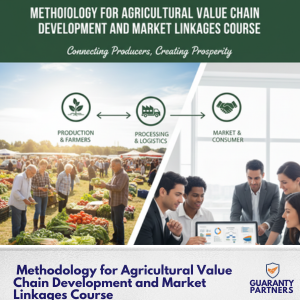
Methodology for Agricultural Value Chain Development and Market Linkages
Course Overview
By the end of this course, participants will be able to:
• Understand the concepts and principles of agricultural value chain development.
• Analyze and map agricultural value chains to identify key stakeholders, processes, and constraints.
• Design interventions to enhance efficiency and competitiveness within value chains.
• Facilitate market linkages between producers, processors, and buyers.
• Apply innovative tools and strategies for improving value chain performance, including leveraging digital platforms.
• Develop sustainable and inclusive models that integrate smallholder farmers and marginalized groups.
• Monitor and evaluate the impact of value chain interventions.
Training Format:In-class, Virtual, In-house
Location:Lagos, Accra, Nairobi, Kigali
Language:English, French
Nigeria Price:
₦350000
Int'l., (Nigeria) Price:
$1000
Ghana Price:
$4000
Kenya Price:
$5500
Rwanda Price:
$6000
Nigeria Price:₦350000
Int'l., (Nigeria) Price:
$1000
Ghana Price:
$4000
Kenya Price:
$4000
Rwanda Price:
$4000
Nigeria Price: ₦350000
Int'l., (Nigeria) Price:
$1000
Ghana Price: $4000
Kenya Price: $4000
Rwanda Price: $4000
Introduction to Agricultural Value Chain Development
• Definition and importance of value chains in agriculture.
• Core concepts: value addition, competitiveness, and market systems.
• Overview of value chain actors and their roles.
Value Chain Analysis and Mapping
• Tools and techniques for value chain mapping.
• Identifying bottlenecks and opportunities for improvement.
• Case studies of successful agricultural value chains.
Market Linkages and Access
• Strategies for connecting farmers to markets.
• Understanding market demand and consumer trends.
• Role of cooperatives, aggregators, and intermediaries in market linkages.
• Digital platforms and e-commerce in agricultural markets.
Designing Value Chain Interventions
• Approaches for upgrading agricultural value chains.
• Promoting quality standards and certifications.
• Financial models to support value chain actors.
• Inclusive strategies to engage smallholder farmers and women.
Risk Management and Resilience
• Identifying and mitigating risks in value chains.
• Building climate-resilient agricultural systems.
• Role of insurance and financial services in risk management.
Monitoring, Evaluation, and Impact Assessment
• Setting indicators for value chain performance.
• Tools for monitoring and evaluating interventions.
• Measuring economic, social, and environmental impacts.
1ST BATCH: Tuesday, April 28, 2026 — Friday, May 1, 2026.
2ND BATCH: Tuesday, August 18, 2026 — Friday, August 21, 2026.
3RD BATCH: Tuesday, December 15, 2026 — Friday, December 18, 2026.
The training methodology integrates lectures, interactive discussions, collaborative group exercises, and
illustrative examples. Participants will acquire a blend of theoretical insights and hands-on practical
experience, emphasizing the application of learned techniques. This approach ensures that attendees return
to their professional environments equipped with both the competence and self-assurance to effectively
implement the acquired skills in their responsibilities.