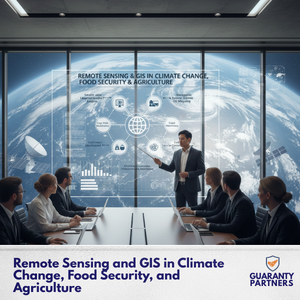
Introduction to Remote Sensing and GIS
• Overview of remote sensing and GIS technologies.
• Basic principles of remote sensing (satellite imagery, aerial photography, sensors).
• Types of remote sensing data (optical, thermal, radar).
• GIS software and tools for spatial data analysis.
• Applications of remote sensing and GIS in environmental monitoring.
Impact of Climate Change on Agriculture and Food Security
• Climate change effects on agriculture (temperature shifts, precipitation patterns).
• Using remote sensing to monitor climate variables (temperature, drought, rainfall).
• GIS for assessing vulnerability in agricultural regions.
• Case studies on climate change impact in agriculture.
• Monitoring crop health and stress using remote sensing technologies.
GIS and Remote Sensing for Agricultural Monitoring
• Role of remote sensing in crop monitoring and yield prediction.
• GIS-based tools for precision agriculture (soil health, crop growth, irrigation management).
• Mapping and monitoring land use and land cover changes in agricultural areas.
• Remote sensing for assessing soil moisture and nutrient levels.
• Application of GIS for farm management and decision support.
Integrating Remote Sensing and GIS for Climate Adaptation and Food Security
• Using remote sensing and GIS to model climate scenarios and agricultural outcomes.
• Identifying and mapping areas at risk for food insecurity.
• GIS for early warning systems in food security and climate disasters.
• Integrating remote sensing data into agricultural policy and planning.
• Future trends in remote sensing, GIS, and climate change adaptation strategies for agriculture.