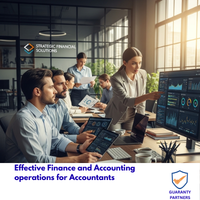
Effective Finance and Accounting operations for Accountants
Course Overview
• Identify the main elements of a vision for finance and accounting
• Evaluate and improve accounts payable process
• List the key best practices in receivables, inventory and cash management
• Assess the budgeting process in their organizations and recommend improvements
• Apply MS Excel reporting and analysis techniques for a faster accounting and finance operations
• Develop an enhanced understanding of the behavioral concepts related to the day-to-day finance and accounting operations
Training Format:In-class, Virtual, In-house
Location:Lagos, Accra, Nairobi, Kigali
Language:English, French
Nigeria Price:
₦30000
Int'l., (Nigeria) Price:
$1000
Ghana Price:
$4000
Kenya Price:
$5500
Rwanda Price:
$6000
Nigeria Price:₦30000
Int'l., (Nigeria) Price:
$1000
Ghana Price:
$4000
Kenya Price:
$4000
Rwanda Price:
$4000
Nigeria Price: ₦30000
Int'l., (Nigeria) Price:
$1000
Ghana Price: $4000
Kenya Price: $4000
Rwanda Price: $4000
• The importance of best practices
o Effectiveness versus efficiency
o Functions of management
o Finance and accounting vision and mission
o Customer service survey
o Purposes and processes of finance and accounting
• The accounting cycle and financial statements
o The accounting processing cycle
o Overview of key financial statements
Income Statement
Balance sheet
Cash flow
• Applying best practices in Accounts Payable (AP)
o Accounts payable life-cycle
o AP common inefficiencies – areas for improvement
o Centralized versus decentralized AP
o AP/supplier portal
o Electronic expense reporting
o Online purchasing catalogue
o Document management system
• Applying best practices in Accounts Receivable (AR), inventory and Cash
o AR Life cycle
Accounting for the allowance for doubtful accounts
Four dimensions in managing AR
Credit policy
Billing
Collection
AR segmentation
o Inventory life-cycle
Costing methods
Valuation and presentation of inventory
Best practices in inventory management
o Best practices in cash management
• Best practices in fixed assets and budgeting
o Fixed assets life-cycle
o Capitalizing versus expensing
o Tracking fixed assets
o Budgeting approaches
o Tips in creating efficiencies in budgeting process
• Reporting best practices using MS Excel
o Consolidating your data
o Validating data for accuracy
o Using pivot tables
Preparing periodic reports in no time
Performing efficient and accurate reconciliation
Bank statement reconciliation
Payroll reporting and analysis
Accounts payable reporting and analysis
General ledger reporting, reconciliation and analysis
Budgeting reporting and analysis
Invoice analysis and reporting
Creating flash management reports
o Enhancing policies and procedures manuals
• Essential behavioral concepts for enhancing Finance and Accounting (F&A) operations
o The new set of skills for F&A
o Clean desk policy
o Peak performance time
o Successful meetings
o Communication skills
o Reviewing and authorization matrix
o Cross training and back up strategies
FOR WHOM: Accountants, Auditors, Finance Officers and others who perform related functions.
1ST BATCH: Tuesday, March 10, 2026 — Friday, February 13, 2026.
2ND BATCH: Tuesday, June 30, 2026 — Friday, July 3, 2026.
3RD BATCH: Tuesday, October 27, 2026 — Friday, October 30, 2026.
The training methodology integrates lectures, interactive discussions, collaborative group exercises, and
illustrative examples. Participants will acquire a blend of theoretical insights and hands-on practical
experience, emphasizing the application of learned techniques. This approach ensures that attendees return
to their professional environments equipped with both the competence and self-assurance to effectively
implement the acquired skills in their responsibilities.