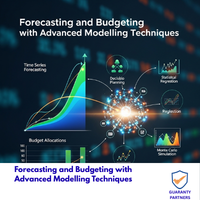
Forecasting and Budgeting with Advanced Modelling Techniques
Course Overview
By the end of this course, participants will be able to:
• Understand the principles and importance of forecasting and budgeting in organizational planning.
• Apply advanced modelling techniques to create accurate financial forecasts and budgets.
• Leverage tools such as Excel, Power BI, and other financial software for data analysis and visualization.
• Develop dynamic budgeting models that adapt to changing business conditions.
• Interpret and utilize statistical and predictive analysis for strategic decision-making.
• Align financial forecasts and budgets with organizational goals and performance metrics.
Training Format:In-class, Virtual, In-house
Location:Lagos, Accra, Nairobi, Kigali
Language:English, French
Nigeria Price:
₦330000
Int'l., (Nigeria) Price:
$1000
Ghana Price:
$4000
Kenya Price:
$5500
Rwanda Price:
$6000
Nigeria Price:₦330000
Int'l., (Nigeria) Price:
$1000
Ghana Price:
$4000
Kenya Price:
$4000
Rwanda Price:
$4000
Nigeria Price: ₦330000
Int'l., (Nigeria) Price:
$1000
Ghana Price: $4000
Kenya Price: $4000
Rwanda Price: $4000
Introduction to Forecasting and Budgeting
• Importance of forecasting and budgeting in strategic planning.
• Key differences between forecasting, budgeting, and financial planning.
• Overview of tools and techniques in financial modelling.
Advanced Forecasting Techniques
• Understanding time-series analysis and trend projection.
• Regression analysis and its application in financial forecasting.
• Scenario analysis and stress testing for business resilience.
• Incorporating external variables (economic indicators, market trends, etc.) into forecasts.
Advanced Budgeting Approaches
• Zero-based budgeting vs. traditional budgeting.
• Activity-based budgeting for cost efficiency.
• Rolling budgets and continuous planning for dynamic businesses.
• Linking budgets to performance metrics and KPIs.
Financial Modelling Tools and Techniques
• Building dynamic models in Excel using advanced formulas and functions.
• Introduction to Power BI for budgeting and forecasting.
• Macros and VBA for automating financial modelling processes.
• Using Monte Carlo simulations for risk assessment and probability forecasting.
Data Analysis for Forecasting and Budgeting
• Data sourcing, cleaning, and preparation for accurate forecasts.
• Statistical tools and techniques for analyzing financial data.
• Data visualization techniques for presenting forecasts and budgets.
• Integration of machine learning techniques in predictive modelling.
Implementation and Monitoring
• Best practices for implementing forecasting and budgeting processes.
• Tools and methods for monitoring budget adherence and forecast accuracy.
• Techniques for variance analysis and corrective actions.
• Building a feedback loop for continuous improvement in forecasting and budgeting
1ST BATCH: Tuesday, February 10, 2026 — Friday, February 13, 2026.
2ND BATCH: Tuesday, June 2, 2026 — Friday, June 5, 2026.
3RD BATCH: Monday, September 28, 2026 — Wednesday, September 30, 2026.
The training methodology integrates lectures, interactive discussions, collaborative group exercises, and
illustrative examples. Participants will acquire a blend of theoretical insights and hands-on practical
experience, emphasizing the application of learned techniques. This approach ensures that attendees return
to their professional environments equipped with both the competence and self-assurance to effectively
implement the acquired skills in their responsibilities.