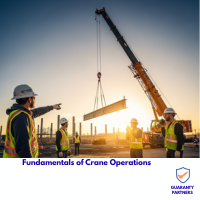
To provide participants with the foundational knowledge and practical understanding required for safe and efficient crane operations. The course introduces the basic principles of crane functionality, load handling techniques, operational procedures, and safety requirements necessary for lifting and moving heavy loads in construction and industrial environments.
Definition and importance of cranes in heavy equipment operations ● Common applications of cranes in construction and industrial projects ● Roles and responsibilities of crane operators and lifting teams ● Overview of crane operational procedures
Types and Classification of Cranes
Mobile cranes and truck-mounted cranes ● Tower cranes and crawler cranes ● Overhead and gantry cranes ● Selection of appropriate crane for specific lifting tasks
Basic Components of a Crane
Crane structure and major parts (boom, jib, hook, counterweights) ● Hoisting mechanisms and wire ropes ● Crane control systems and operator cabin ● Safety devices and warning systems
Principles of Safe Lifting Operations
Understanding load weight and crane capacity ● Load stability and center of gravity ● Load charts and lifting limits ● Safe positioning and setup of cranes
Crane Operational Safety Practices
● Pre-operational inspection and safety checks ● Communication between crane operator and signalers ● Hazard identification during lifting operations ● Emergency procedures during crane operation
The training methodology integrates lectures, interactive discussions, collaborative group exercises, and illustrative examples. Participants will acquire a blend of theoretical insights and hands-on practical experience, emphasizing the application of learned techniques. This approach ensures that attendees return to their professional environments equipped with both the competence and self-assurance to effectively implement the acquired skills in their responsibilities.