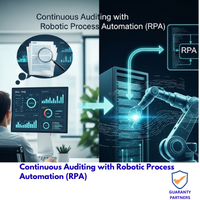
Continuous Auditing with Robotic Process Automation (RPA)

Course Overview

  • Understand the fundamentals of continuous auditing and its role in modern audit practices.
  • Learn the basics of Robotic Process Automation (RPA) and its application in auditing.
  • Explore techniques to implement continuous auditing using RPA tools effectively.
  • Gain hands-on experience in designing simple RPA workflows for audit tasks.

Training Format:In-class, Virtual, In-house

Location:Lagos, Accra, Nairobi, Kigali

Language:English, French

Nigeria Price:
₦300000

Int'l., (Nigeria) Price:
$1000

Ghana Price:
$4000

Kenya Price:
$5500

Rwanda Price:
$6000

Nigeria Price:₦300000

Int'l., (Nigeria) Price:
$1000

Ghana Price:
$4000

Kenya Price:
$4000

Rwanda Price:
$4000

Nigeria Price: ₦300000

Int'l., (Nigeria) Price:
$1000

Ghana Price: $4000

Kenya Price: $4000

Rwanda Price: $4000

Introduction to Continuous Auditing and RPA

  • Overview of Continuous Auditing:
    • Definition and importance in modern auditing.
    • Key differences between traditional and continuous auditing.
  • Introduction to RPA:
    • What is RPA?
    • Benefits of RPA in auditing and compliance.
  • Case studies: Real-world examples of RPA in audit scenarios.

RPA Tools and Frameworks for Auditing

  • Overview of popular RPA tools (e.g., UiPath, Automation Anywhere, Blue Prism).
  • Key features relevant to auditing:
    • Data extraction and validation.
    • Process monitoring and exception reporting.
  • Criteria for selecting RPA tools for auditing.
  • Demonstration: Basic RPA workflow for extracting audit data.

Designing RPA-Driven Continuous Auditing Processes

  • Steps to design an RPA-enabled continuous auditing process:
    • Identifying audit processes suitable for automation.
    • Data integration and processing.
  • Workflow optimization: Ensuring scalability and reliability.
  • Addressing risks and challenges in RPA-driven auditing:
    • Data security and compliance considerations.
    • Handling system exceptions and errors.
  • Hands-on activity: Create a basic audit automation workflow.

Implementing and Monitoring RPA in Continuous Auditing

  • Implementation strategies:
    • Piloting RPA for auditing.
    • Gradual scaling across audit functions.
  • Monitoring and maintaining RPA processes:
    • Ongoing validation and updates.
    • KPI tracking for continuous improvement.
  • Discussion: Lessons learned from successful RPA implementations.
  • Final project: Develop a simple continuous audit use case with RPA.

1ST BATCH: Tuesday, February 3, 2026 — Friday, February 6, 2026.

2ND BATCH: Tuesday, May 26, 2026 — Friday, May 29, 2026.

3RD BATCH: Tuesday, September 22, 2026 — Friday, September 25, 2026.

The training methodology integrates lectures, interactive discussions, collaborative group exercises, and
illustrative examples. Participants will acquire a blend of theoretical insights and hands-on practical
experience, emphasizing the application of learned techniques. This approach ensures that attendees return
to their professional environments equipped with both the competence and self-assurance to effectively
implement the acquired skills in their responsibilities.

Facebook
WhatsApp
X
Threads
Telegram
Print