
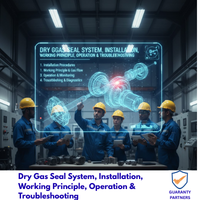
Dry Gas Seal System, Installation, Working Principle, Operation & Troubleshooting
Course Overview
The primary objective of this Gas Turbine Operation, Performance, Maintenance and Repair training program is to empower professionals with—
• detailed information and knowledge about gas turbines, including their operation, performance, maintenance and troubleshooting
• the required skills to successfully handle processes involving gas turbines
• the ability to make appropriate, timely decisions related to the choice of material and type of turbine as per the intended purpose
• the necessary confidence and knowledge to train other professionals to efficiently work with gas turbines
• the experience and exposure to review current systems and make enhancements to improve operational efficiency and demonstrate skill and talent
• the confidence to face all challenges when working with gas turbines and not let these impact the organisation
• the ability to contribute to operational efficiency and reduction in operational and maintenance costs, thereby demonstrating potential to undertake higher roles and responsibilities
• the capabilities to ensure adherence to all standards set out for working with gas turbines
• a sense of pride contributing to organisational development through reduced costs and increased operational efficiency
Training Format:In-class, Virtual, In-house
Location:Lagos, Accra, Nairobi, Kigali
Language:English, French
Nigeria Price:
₦350000
Int'l., (Nigeria) Price:
$1000
Ghana Price:
$4000
Kenya Price:
$5500
Rwanda Price:
$6000
Nigeria Price:₦350000
Int'l., (Nigeria) Price:
$1000
Ghana Price:
$4000
Kenya Price:
$4000
Rwanda Price:
$4000
Nigeria Price: ₦350000
Int'l., (Nigeria) Price:
$1000
Ghana Price: $4000
Kenya Price: $4000
Rwanda Price: $4000
Types of Dry Gas Seal Configurations
• Single seal
• Tandem seal
• Double opposed seal
• Separation seal
Storage and Protection of Dry Gas Seals
• Dry storage place
• Prevention from radiation, heat, steam and ozone
• No use of corrosion protection agents
• Re-qualification of seal cartridge before installation
• Protection of spare gaskets from heat sources
Basic Installation Pre-Requisites
• Follow plant safety regulations
• Secure mixer or agitator shaft
• Remove coupling and/or drive
• Remove existing seal assembly
• Remove burrs and sharp edges
• Check shaft and vessel flange requirements
• Check assembly drawing
• Check shaft OD, vessel flange bolt size, bolt circle and distance to coupling/drive
• Handle seal assembly with care
• Pressure testing
Steps in Dry Gas Seal Installation
• Equipment check
• Seal installation
• Dry gas supply
• Seal piping
• Seal operation
• Repairs
Seal Operation Guidelines
• Maintain dry gas supply pressure
• Do not exceed maximum barrier pressure
• Do not exceed maximum vessel pressure
• Do not exceed maximum vessel temperature
• Do not exceed seal material corrosion limits
Sources of Dry Gas Seal Contamination
• Process gas
• Bearing lubrication oil
• Seal gas supply
Dry Gas Seal System Improvements
• Seal gas filter system
• Operation range of seal system instruments
• Seal gas booster
• Burst-alert for rupture disc
• Flowmeter on secondary vent
• Differential pressure on any seal stage
• Additional flowmeters on the primary vent for double-checking
Common Modes of Dry Gas Seal Failure
• Contamination
• Condensation
• Misalignment
• Explosive decompression
• Reverse pressurisation
• Reverse rotation
• Failure at transient conditions
Causes of Leaking Losses
• Ill-fitting sealing elements
• Installation faults
• Construction faults
• Wear and tear
• Ageing
• Equipment failure
• Sealing element contamination
• Excursions out of normal process conditions
• Poor maintenance procedures
1ST BATCH: Tuesday, January 20, 2026 — Friday, January 23, 2026.
2ND BATCH: Tuesday, May 12, 2026 — Friday, May 15, 2026.
3RD BATCH: Tuesday, September 8, 2026 — Friday, September 11, 2026.
The training methodology integrates lectures, interactive discussions, collaborative group exercises, and
illustrative examples. Participants will acquire a blend of theoretical insights and hands-on practical
experience, emphasizing the application of learned techniques. This approach ensures that attendees return
to their professional environments equipped with both the competence and self-assurance to effectively
implement the acquired skills in their responsibilities.