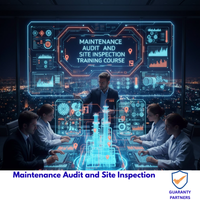
Maintenance Audit and Site Inspection
Course Overview
The objectives of the Maintenance Audit and Site Inspection course make the trainees to:
• Having insights about the market trends and developing skills to keep an eagle’s eye on the maintenance of the assets
• Understanding how the audit is related to the management of the assets and how it can help the organization improve its work to achieve its goal
• Conducting standardized site inspections for the company
• Comprehend the significance of the pre-audit and pre-inspection questionnaires
• Apprehending the working and application of the international standards such as ISO 55000 and PAS 55
• Learning how to interpret the results and develop a sound action plan for real improvements
• Effective audit and inspection techniques are used to fill up the gap between current performance and potential improvements
• Understanding all the theory-related concepts
• Starting with the basic and upgrading to the advanced level
• Comprehend the impact of the international standard on the inspection and audit
Training Format:In-class, Virtual, In-house
Location:Lagos, Accra, Nairobi, Kigali
Language:English, French
Nigeria Price:
₦350000
Int'l., (Nigeria) Price:
$1000
Ghana Price:
$4000
Kenya Price:
$5500
Rwanda Price:
$6000
Nigeria Price:₦350000
Int'l., (Nigeria) Price:
$1000
Ghana Price:
$4000
Kenya Price:
$4000
Rwanda Price:
$4000
Nigeria Price: ₦350000
Int'l., (Nigeria) Price:
$1000
Ghana Price: $4000
Kenya Price: $4000
Rwanda Price: $4000
All crucial topics and concepts that will be covered in the Maintenance Audit and Site Inspection course session are given below:
Introduction to the Maintenance Audit and Site Inspection
• What is a Maintenance Audit?
• What is Site Inspection?
• Difference between Audit and Inspection.
• Why each of these processes are needed?
• What are the benefits of the Maintenance audit and Site Inspection?
Types of Maintenance Audit
• Voluntary
• Internal
• Mandatory
• What happens in each of the types?
Activities in the Maintenance Audits
• Activities performed before the audit
• Activities performed “During the audit”
• Activities performed after the audit
• What is actually examined during the audit?
A Deep Dive into Maintenance Audit
• Maintenance Audit: A purely Business Process
• Landscape Model
• Framework Strategy
o Sightline
o Policy of managing assets
o Setting up goals
o Developing a plan
o Measuring the outcomes
o Feedback
o Improving
• Some practical tips
International Standards
• PAS 55
• ISO 55000
Risk and Maintenance Audit
• Risk Management
• Important concepts of the risk maintenance
• Engineering of the system: RAMS
• Principles of the whole life costing
• Management of the Workflow
• KPIs
• Improvement, people, and organization
Maintenance Auditing Techniques and Principles
• A basic flow from preparation to reporting (Principles)
• Process of the Audit
• Analysis of the Gap
• Benchmarking
Site Inspection
• Techniques for the better observation
• Physical inspection
• Space Entry (confined)
• Equipment lifting
• Scaffolding
• Working at high places
• Chemicals
• PIPE
• Work permit systems
• Ladders
• Fire Assessment
Emergency Types
• Auditing reports
• Internal
• Auditing emergency plans
• External
Safety Culture
• What is safety culture?
• Behavioral safety
• Some motivation: Maslow, Taylor, Herzberg, Gueller, Vroom
• ABC analysis
• Natural penalties
• Driving force of the behaviour
• Safety culture and auditing
Interpretation of the Results
• Setting up the goals
• Determining potential to improve
• Presenting work packages
• Showing the improvement plan
• Multi-criteria analysis
• Management change
Winding up with the workshop
• Sharing some real-world examples
• Marketplace Application
1ST BATCH: Monday, March 16, 2026 — Thursday, March 19, 2026.
2ND BATCH: Tuesday, July 7, 2026 — Friday, July 10, 2026.
3RD BATCH: Tuesday, November 3, 2026 — Friday, November 6, 2026.
The training methodology integrates lectures, interactive discussions, collaborative group exercises, and
illustrative examples. Participants will acquire a blend of theoretical insights and hands-on practical
experience, emphasizing the application of learned techniques. This approach ensures that attendees return
to their professional environments equipped with both the competence and self-assurance to effectively
implement the acquired skills in their responsibilities.