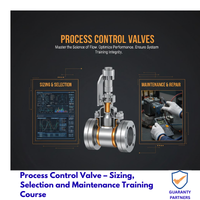
Process Control Valve – Sizing, Selection and Maintenance Training Course

Course Overview

• Equip participants with technical knowledge and skills to select, size, and maintain process control valves effectively
• Strengthen understanding of valve types, applications, and performance criteria in industrial systems
• Enhance operational efficiency, reliability, and safety in process control operations
• Promote best practices in maintenance, troubleshooting, and documentation

Training Format:In-class, Virtual, In-house

Location:Lagos, Accra, Nairobi, Kigali

Language:English, French

Nigeria Price:
₦350000

Int'l., (Nigeria) Price:
$1000

Ghana Price:
$4000

Kenya Price:
$5500

Rwanda Price:
$6000

Nigeria Price:₦350000

Int'l., (Nigeria) Price:
$1000

Ghana Price:
$4000

Kenya Price:
$4000

Rwanda Price:
$4000

Nigeria Price: ₦350000

Int'l., (Nigeria) Price:
$1000

Ghana Price: $4000

Kenya Price: $4000

Rwanda Price: $4000

Introduction to Process Control Valves

• Definition and function of control valves in process systems
• Types of valves: globe, ball, butterfly, diaphragm, and others
• Importance of valves in regulating flow, pressure, and temperature
• Overview of process control systems and instrumentation

Valve Sizing Principles

• Understanding flow characteristics and valve sizing equations
• Calculating Cv, flow coefficients, and pressure drops
• Matching valve capacity to process requirements
• Using sizing software and tools for accurate selection

Valve Selection Criteria

• Material selection based on fluid type and operating conditions
• Compatibility with temperature, pressure, and corrosion resistance requirements
• Selecting actuators and control mechanisms
• Evaluating valve performance for efficiency and reliability

Installation and Commissioning of Valves

• Proper installation techniques and alignment
• Piping, flanges, and sealing considerations
• Pre-commissioning checks and functional testing
• Troubleshooting common installation issues

Valve Maintenance and Troubleshooting

• Routine inspection, cleaning, and lubrication
• Identifying and resolving common valve failures
• Predictive and preventive maintenance techniques
• Record-keeping and maintenance scheduling

Safety, Compliance, and Best Practices

• Occupational safety and environmental considerations
• Compliance with industry standards and manufacturer guidelines
• Documentation of maintenance and operational procedures
• Continuous improvement and knowledge updates

1ST BATCH: Tuesday, February 10, 2026 — Friday, February 13, 2026.

2ND BATCH: Tuesday, June 2, 2026 — Friday, June 5, 2026.

3RD BATCH: Monday, September 28, 2026 — Wednesday, September 30, 2026.

The training methodology integrates lectures, interactive discussions, collaborative group exercises, and
illustrative examples. Participants will acquire a blend of theoretical insights and hands-on practical
experience, emphasizing the application of learned techniques. This approach ensures that attendees return
to their professional environments equipped with both the competence and self-assurance to effectively
implement the acquired skills in their responsibilities.

Facebook
WhatsApp
X
Threads
Telegram
Print