

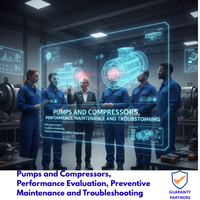
Pumps and Compressors, Performance Evaluation, Preventive Maintenance and Troubleshooting
Course Overview
Pumps and Compressors, Performance Evaluation, Preventive Maintenance and Troubleshooting training course is to empower professionals with—
• a comprehensive understanding of pump and compressor operations, performance, preventative maintenance and troubleshooting
• the necessary experience and confidence to handle any challenge related to pumps and/or compressors
• the experience to closely examine existing machinery employing pumps and/or compressors to check for maintenance or damage control
• the required foresight to predict damages that could pose a serious threat soon, and make changes to ensure that business is not impacted
• adequate confidence and knowledge to train other professionals on pumps and compressors
• the ability to contribute to organisational development through reduced costs and better equipment
• the knowledge and awareness of international standards and protocols to be followed
• the overall skill set and capabilities to manage responsibilities related to pump and/or compressor operations
Training Format:In-class, Virtual, In-house
Location:Lagos, Accra, Nairobi, Kigali
Language:English, French
Nigeria Price:
₦350000
Int'l., (Nigeria) Price:
$1000
Ghana Price:
$4000
Kenya Price:
$5500
Rwanda Price:
$6000
Nigeria Price:₦350000
Int'l., (Nigeria) Price:
$1000
Ghana Price:
$4000
Kenya Price:
$4000
Rwanda Price:
$4000
Nigeria Price: ₦350000
Int'l., (Nigeria) Price:
$1000
Ghana Price: $4000
Kenya Price: $4000
Rwanda Price: $4000
Components of a Pump or Compressor Station
• Scrubber or inlet separator to remove liquids
• Filter to remove contaminants
• Gas coolers
• Heater and cooler
• Fuel gas system
• Station flow measurement
• Auxiliary power unit
• Compressed air system
• Power gas system
• High voltage electrical system
• Security system
• Building heating system
Factors Playing a Role in Determining Pump and Compressor Stations
• Size and configuration of drivers and compressors or pumps
• Climatic conditions
• Location relative to support resources
• Regulatory, environmental and safety requirements
• Proximity to inhabited areas
Factors Influencing Selection of Pump or Compressor Unit
• Performance ratings and load cycles
• Installation requirements and constraints
• Configuration options
• Type of energy source
• Maintenance support resources
• Life cycle costs
• Noise and exhaust emission requirements
Types of Compressors
• Positive displacement
o Reciprocating compressors
o Ionic liquid piston compressor
o Rotary screw compressors
o Rotary vane compressors
o Rolling piston
o Scroll compressors
o Diaphragm compressors
• Dynamic
o Air bubble compressor
o Centrifugal compressors
o Diagonal or mixed-flow compressors
o Axial compressors
• Hermetically sealed, open or semi-hermetic
Parameters Assessed for Centrifugal Compressor Performance
• Flows
• Efficiencies
• Heads
• Speeds
Parameters to be Monitored for Compressor Maintenance
• Motor temperature
• Vibration
• Motor current
Air Compressor Troubleshooting Aspects
• Compressor not operating
• Excessive noise during operation
• Knock – same cycle as RPM
• Knock while compressor is loading
• Milky oil in oil reservoir
• Excessive oil consumption
• Oil in discharge air
• Compressor vibration
• Air blowing out of inlet
• Insufficient pressure at point of use
• Excessive belt wear
• Excessive discharge air temperature
• Repeated fuse blows
• Sudden stop of the compressor
Types of Pumps
• Getter-ion or sputter-ion pumps
• Cryopumps
• Sorption pumps
• Non-evaporable getter pumps
• Turbomolecular pumps
Steps of Setting-Up a Centrifugal Pump
1ST BATCH: Tuesday, January 20, 2026 — Friday, January 23, 2026.
2ND BATCH: Tuesday, May 12, 2026 — Friday, May 15, 2026.
3RD BATCH: Tuesday, September 8, 2026 — Friday, September 11, 2026.
The training methodology integrates lectures, interactive discussions, collaborative group exercises, and
illustrative examples. Participants will acquire a blend of theoretical insights and hands-on practical
experience, emphasizing the application of learned techniques. This approach ensures that attendees return
to their professional environments equipped with both the competence and self-assurance to effectively
implement the acquired skills in their responsibilities.