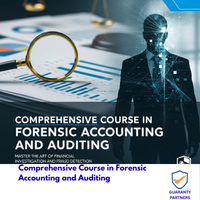
Comprehensive Course in Forensic Accounting and Auditing
Course Overview
• Understand the principles and practices of forensic accounting and auditing.
• Recognize the importance of forensic accounting in fraud detection and investigation.
• Familiarize with the legal and regulatory framework governing forensic accounting and auditing.
• Develop skills in fraud detection techniques and data analysis for forensic purposes.
• Learn investigation methodologies and techniques for gathering evidence effectively.
• Gain proficiency in preparing forensic accounting reports and presenting findings as an expert witness.
• Explore the role of cyber forensics and digital evidence in forensic accounting investigations.
• Apply forensic accounting techniques through case studies and practical exercises.
• Stay updated on emerging trends and future directions in forensic accounting and auditing.
• Understand the certification and career development opportunities available in the field of forensic accounting.
Training Format:In-class, Virtual, In-house
Location:Lagos, Accra, Nairobi, Kigali
Language:English, French
Nigeria Price:
₦300000
Int'l., (Nigeria) Price:
$1000
Ghana Price:
$4000
Kenya Price:
$5500
Rwanda Price:
$6000
Nigeria Price:₦300000
Int'l., (Nigeria) Price:
$1000
Ghana Price:
$4000
Kenya Price:
$4000
Rwanda Price:
$4000
Nigeria Price: ₦300000
Int'l., (Nigeria) Price:
$1000
Ghana Price: $4000
Kenya Price: $4000
Rwanda Price: $4000
Introduction to Forensic Accounting and Auditing
• Overview of forensic accounting principles and practices
• Role and importance of forensic accounting in fraud detection and investigation
• Introduction to forensic auditing and its relevance in financial investigations
Legal and Regulatory Framework
• Understanding relevant laws, regulations, and standards governing forensic accounting and auditing
• Legal aspects of fraud investigation and evidence collection
• Compliance requirements and ethical considerations in forensic accounting
Fraud Detection Techniques
• Techniques for identifying red flags and indicators of fraud in financial statements
• Data analytics and forensic tools for detecting irregularities and anomalies
• Case studies and real-life examples of fraudulent activities and detection methods
Investigation Methodologies
• Steps and procedures involved in conducting forensic investigations
• Interviewing techniques and interrogation methods for gathering evidence
• Document examination and forensic analysis of financial records
Financial Reporting and Expert Witness Testimony
• Preparation of forensic accounting reports and documentation
• Presenting findings and conclusions as an expert witness in legal proceedings
• Role of forensic accountants in litigation support and dispute resolution
Cyber Forensics and Digital Evidence
• Understanding digital forensics and its application in fraud investigations
• Techniques for collecting, preserving, and analyzing electronic evidence
• Cybersecurity measures and data protection in forensic accounting practices
Case Studies and Practical Applications
• Analysis of real-world cases and forensic accounting scenarios
• Hands-on exercises and simulations to apply forensic techniques and methodologies
• Role-playing exercises for conducting forensic interviews and presenting findings
Emerging Trends and Future Directions
• Latest developments and trends in forensic accounting and auditing
• Technological advancements and their impact on forensic investigations
• Opportunities and challenges in the field of forensic accounting for future practitioners
FOR WHOM:
Auditors, Accountants, Chief Financial Officers, Financial professionals, Directors, Risk managers, Board Members, Shareholders, investors, Legal professionals,
1ST BATCH: Tuesday, February 17, 2026 — Friday, February 20, 2026.
2ND BATCH: Tuesday, June 9, 2026 — Friday, June 12, 2026.
3RD BATCH: Tuesday, October 6, 2026 — Friday, October 9, 2026.
The training methodology integrates lectures, interactive discussions, collaborative group exercises, and
illustrative examples. Participants will acquire a blend of theoretical insights and hands-on practical
experience, emphasizing the application of learned techniques. This approach ensures that attendees return
to their professional environments equipped with both the competence and self-assurance to effectively
implement the acquired skills in their responsibilities.