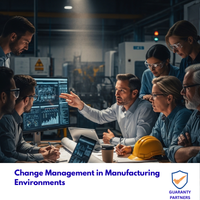
Change Management in Manufacturing Environments
Course Overview
- Understand the principles and importance of change management in manufacturing.
- Learn how to manage resistance to change within the workforce.
- Develop strategies for effective communication during change.
- Implement tools and techniques for successful change management in manufacturing processes.
Training Format:In-class, Virtual, In-house
Location:Lagos, Accra, Nairobi, Kigali
Language:English, French
Nigeria Price:
₦350000
Int'l., (Nigeria) Price:
$1000
Ghana Price:
$4000
Kenya Price:
$5500
Rwanda Price:
$6000
Nigeria Price:₦350000
Int'l., (Nigeria) Price:
$1000
Ghana Price:
$4000
Kenya Price:
$4000
Rwanda Price:
$4000
Nigeria Price: ₦350000
Int'l., (Nigeria) Price:
$1000
Ghana Price: $4000
Kenya Price: $4000
Rwanda Price: $4000
Understanding Change Management in Manufacturing
- Definition of change management.
- Importance of change in manufacturing environments.
- Key challenges faced during change initiatives.
- Overview of the change management process.
Managing Resistance to Change
- Common sources of resistance in manufacturing settings.
- Psychological and cultural factors affecting change.
- Strategies to overcome resistance.
- Role of leadership in managing resistance.
Effective Communication During Change
- The role of communication in successful change management.
- Key communication strategies and tools.
- Tailoring communication to different audiences.
- Importance of feedback loops and transparency.
Tools and Techniques for Successful Change Implementation
- Change management models and frameworks (e.g., Kotter’s 8-Step Process).
- Lean manufacturing and Six Sigma tools for process change.
- Training and support mechanisms for employees.
- Measuring the success of change initiatives and ensuring sustainability.
1ST BATCH: Monday, March 16, 2026 — Thursday, March 19, 2026.
2ND BATCH: Tuesday, July 14, 2026 — Friday, July 17, 2026.
3RD BATCH: Tuesday, December 1, 2026 — Friday, December 4, 2026.
The training methodology integrates lectures, interactive discussions, collaborative group exercises, and
illustrative examples. Participants will acquire a blend of theoretical insights and hands-on practical
experience, emphasizing the application of learned techniques. This approach ensures that attendees return
to their professional environments equipped with both the competence and self-assurance to effectively
implement the acquired skills in their responsibilities.