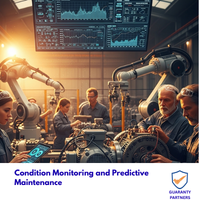
Condition Monitoring and Predictive Maintenance
Course Overview
- Understand the principles of condition monitoring and predictive maintenance.
- Learn various techniques and tools for condition monitoring.
- Explore the integration of predictive maintenance into operational strategies.
- Develop the ability to assess the effectiveness of predictive maintenance systems.
Training Format:In-class, Virtual, In-house
Location:Lagos, Accra, Nairobi, Kigali
Language:English, French
Nigeria Price:
₦350000
Int'l., (Nigeria) Price:
$1000
Ghana Price:
$4000
Kenya Price:
$5500
Rwanda Price:
$6000
Nigeria Price:₦350000
Int'l., (Nigeria) Price:
$1000
Ghana Price:
$4000
Kenya Price:
$4000
Rwanda Price:
$4000
Nigeria Price: ₦350000
Int'l., (Nigeria) Price:
$1000
Ghana Price: $4000
Kenya Price: $4000
Rwanda Price: $4000
Introduction to Condition Monitoring and Predictive Maintenance
- Overview of condition monitoring and predictive maintenance
- Key benefits and differences between preventive and predictive maintenance
- Importance of condition monitoring in asset management
- Key performance indicators (KPIs) for monitoring equipment health
Condition Monitoring Techniques
- Vibration analysis and its applications
- Thermal imaging and infrared thermography
- Oil analysis and lubrication monitoring
- Acoustic emission monitoring
- Ultrasonic testing for leak detection
Predictive Maintenance Strategies and Tools
- Predictive algorithms and data analytics in maintenance
- Condition-based monitoring vs. time-based maintenance
- Role of IoT and sensors in predictive maintenance
- Integration with Computerized Maintenance Management Systems (CMMS)
Implementation and Effectiveness Assessment
- Steps to implement a predictive maintenance program
- Evaluating the success of predictive maintenance systems
1ST BATCH: Tuesday, March 10, 2026 — Friday, March 13, 2026.
2ND BATCH: Tuesday, July 7, 2026 — Friday, July 10, 2026.
3RD BATCH: Tuesday, November 24, 2026 — Friday, November 27, 2026.
The training methodology integrates lectures, interactive discussions, collaborative group exercises, and
illustrative examples. Participants will acquire a blend of theoretical insights and hands-on practical
experience, emphasizing the application of learned techniques. This approach ensures that attendees return
to their professional environments equipped with both the competence and self-assurance to effectively
implement the acquired skills in their responsibilities.