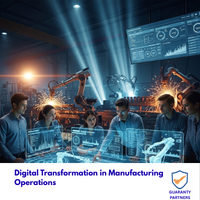
Digital Transformation in Manufacturing Operations

Course Overview

  • Understand the role of digital transformation in modern manufacturing.
  • Explore key technologies driving digital transformation.
  • Learn how to implement digital tools to optimize manufacturing operations.
  • Examine real-world case studies and best practices in digital transformation.

Training Format:In-class, Virtual, In-house

Location:Lagos, Accra, Nairobi, Kigali

Language:English, French

Nigeria Price:
₦350000

Int'l., (Nigeria) Price:
$1000

Ghana Price:
$4000

Kenya Price:
$5500

Rwanda Price:
$6000

Nigeria Price:₦350000

Int'l., (Nigeria) Price:
$1000

Ghana Price:
$4000

Kenya Price:
$4000

Rwanda Price:
$4000

Nigeria Price: ₦350000

Int'l., (Nigeria) Price:
$1000

Ghana Price: $4000

Kenya Price: $4000

Rwanda Price: $4000

Introduction to Digital Transformation in Manufacturing

  • Definition and importance of digital transformation in manufacturing.
  • The evolution of manufacturing from traditional to digital processes.
  • Key drivers of digital transformation: Industry 4.0, IoT, AI, and Big Data.
  • Benefits of digital transformation in manufacturing operations.

Key Technologies Driving Digital Transformation

  • Internet of Things (IoT) and its impact on manufacturing efficiency.
  • Artificial Intelligence (AI) and Machine Learning in predictive maintenance.
  • Robotics and automation in production lines.
  • Cloud computing and data analytics for real-time decision-making.

Implementing Digital Tools in Manufacturing Operations

  • Integrating IoT sensors for data collection and monitoring.
  • Adopting AI-powered solutions for process optimization.
  • The role of cloud-based platforms in improving operational visibility.
  • Strategies for managing data flow and ensuring cybersecurity in digital systems.

1ST BATCH: Tuesday, April 14, 2026 — Friday, April 17, 2026.

2ND BATCH: Tuesday, August 11, 2026 — Friday, August 14, 2026.

3RD BATCH: Tuesday, December 15, 2026 — Friday, December 18, 2026.

The training methodology integrates lectures, interactive discussions, collaborative group exercises, and
illustrative examples. Participants will acquire a blend of theoretical insights and hands-on practical
experience, emphasizing the application of learned techniques. This approach ensures that attendees return
to their professional environments equipped with both the competence and self-assurance to effectively
implement the acquired skills in their responsibilities.

Facebook
WhatsApp
X
Threads
Telegram
Print