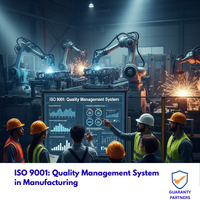
ISO 9001: Quality Management System in Manufacturing
Course Overview
- Understand the principles and requirements of ISO 9001.
- Learn how to implement a Quality Management System (QMS) in a manufacturing environment.
- Understand the role of leadership in driving quality management.
- Gain knowledge of continuous improvement and how it applies to manufacturing.
Training Format:In-class, Virtual, In-house
Location:Lagos, Accra, Nairobi, Kigali
Language:English, French
Nigeria Price:
₦350000
Int'l., (Nigeria) Price:
$1000
Ghana Price:
$4000
Kenya Price:
$5500
Rwanda Price:
$6000
Nigeria Price:₦350000
Int'l., (Nigeria) Price:
$1000
Ghana Price:
$4000
Kenya Price:
$4000
Rwanda Price:
$4000
Nigeria Price: ₦350000
Int'l., (Nigeria) Price:
$1000
Ghana Price: $4000
Kenya Price: $4000
Rwanda Price: $4000
Introduction to ISO 9001 and Quality Management Systems
- Overview of ISO 9001 and its importance in manufacturing.
- Key principles of quality management: customer focus, leadership, engagement of people, process approach, improvement, evidence-based decision making, relationship management.
- Structure and clauses of ISO 9001:2015.
- Benefits of ISO 9001 implementation in manufacturing.
Implementing a Quality Management System (QMS)
- Steps in implementing ISO 9001 in manufacturing.
- Documentation requirements: quality manual, procedures, work instructions.
- Roles and responsibilities in QMS implementation.
- Creating a quality policy and objectives.
- Internal audits and their importance in QMS.
Leadership and Employee Involvement in Quality Management
- The role of leadership in ISO 9001 implementation.
- Building a quality culture within the organization.
- Employee training and engagement for quality.
- Effective communication and feedback loops.
- Responsibilities of top management in sustaining QMS.
1ST BATCH: Tuesday, February 17, 2026 — Friday, February 20, 2026.
2ND BATCH: Tuesday, June 9, 2026 — Friday, June 12, 2026.
3RD BATCH: Tuesday, October 6, 2026 — Tuesday, October 6, 2026.
The training methodology integrates lectures, interactive discussions, collaborative group exercises, and
illustrative examples. Participants will acquire a blend of theoretical insights and hands-on practical
experience, emphasizing the application of learned techniques. This approach ensures that attendees return
to their professional environments equipped with both the competence and self-assurance to effectively
implement the acquired skills in their responsibilities.