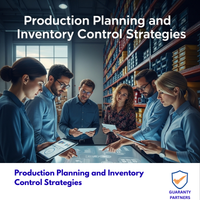
Production Planning and Inventory Control Strategies

Course Overview

  • Understand the principles of production planning and inventory control
  • Develop skills to optimize production processes and inventory levels
  • Implement strategies to reduce costs and enhance operational efficiency
  • Analyze demand forecasting and its impact on production planning
  • Utilize inventory control techniques to improve supply chain performance

Training Format:In-class, Virtual, In-house

Location:Lagos, Accra, Nairobi, Kigali

Language:English, French

Nigeria Price:
₦350000

Int'l., (Nigeria) Price:
$1000

Ghana Price:
$4000

Kenya Price:
$5500

Rwanda Price:
$6000

Nigeria Price:₦350000

Int'l., (Nigeria) Price:
$1000

Ghana Price:
$4000

Kenya Price:
$4000

Rwanda Price:
$4000

Nigeria Price: ₦350000

Int'l., (Nigeria) Price:
$1000

Ghana Price: $4000

Kenya Price: $4000

Rwanda Price: $4000

Introduction to Production Planning and Inventory Control

  • Key concepts of production planning
  • Importance of inventory control in manufacturing
  • Balancing demand and supply in production
  • Types of production systems and inventory

Techniques for Effective Production Planning

  • Master production scheduling (MPS)
  • Material requirements planning (MRP)
  • Capacity planning and resource allocation
  • Role of lean manufacturing in production efficiency

Inventory Control Strategies

  • ABC analysis for inventory management
  • Economic Order Quantity (EOQ) and Just-in-Time (JIT) methods
  • Safety stock and reorder point determination
  • Inventory tracking systems and tools

Integrating Production Planning and Inventory Management

  • Aligning production plans with inventory goals
  • Demand forecasting and inventory optimization
  • Managing supply chain disruptions
  • Measuring performance through KPIs and analytics

1ST BATCH: Tuesday, January 13, 2026 — Friday, January 16, 2026.

2ND BATCH: Tuesday, May 5, 2026 — Friday, May 8, 2026.

3RD BATCH: Tuesday, September 1, 2026 — Friday, September 4, 2026.

The training methodology integrates lectures, interactive discussions, collaborative group exercises, and
illustrative examples. Participants will acquire a blend of theoretical insights and hands-on practical
experience, emphasizing the application of learned techniques. This approach ensures that attendees return
to their professional environments equipped with both the competence and self-assurance to effectively
implement the acquired skills in their responsibilities.

Facebook
WhatsApp
X
Threads
Telegram
Print