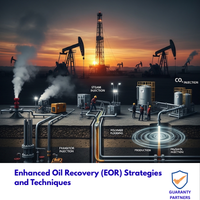
Enhanced Oil Recovery (EOR) Strategies and Techniques
Course Overview
- Understand the principles and importance of Enhanced Oil Recovery (EOR) in oil production.
- Explore key EOR strategies, methods, and techniques for maximizing oil recovery.
- Identify challenges, opportunities, and best practices in implementing EOR technologies.
- Evaluate the economic and environmental considerations of EOR projects.
Training Format:In-class, Virtual, In-house
Location:Lagos, Accra, Nairobi, Kigali
Language:English, French
Nigeria Price:
₦360000
Int'l., (Nigeria) Price:
$1000
Ghana Price:
$4000
Kenya Price:
$5500
Rwanda Price:
$6000
Nigeria Price:₦360000
Int'l., (Nigeria) Price:
$1000
Ghana Price:
$4000
Kenya Price:
$4000
Rwanda Price:
$4000
Nigeria Price: ₦360000
Int'l., (Nigeria) Price:
$1000
Ghana Price: $4000
Kenya Price: $4000
Rwanda Price: $4000
Introduction to Enhanced Oil Recovery (EOR)
- Definition and significance of EOR
- Comparison of primary, secondary, and tertiary recovery methods
- Factors influencing EOR selection
- Overview of EOR classification: thermal, chemical, and gas injection
Thermal Recovery Techniques
- Steam flooding and cyclic steam injection
- In-situ combustion methods
- Heat transfer mechanisms in reservoirs
- Case studies of thermal recovery success
Chemical and Gas Injection Techniques
- Chemical EOR methods: polymer flooding, surfactant flooding, and alkaline flooding
- CO₂ injection and nitrogen injection methods
- Mechanisms of chemical and gas displacement in reservoirs
- Key considerations for chemical and gas EOR applications
Challenges, Economics, and Future Trends in EOR
- Technical and operational challenges in EOR implementation
- Cost-benefit analysis and economic feasibility of EOR projects
- Environmental impact and sustainability of EOR techniques
- Innovations and emerging technologies in EOR
1ST BATCH: Tuesday, January 13, 2026 — Friday, January 16, 2026.
2ND BATCH: Tuesday, May 5, 2026 — Friday, May 8, 2026.
3RD BATCH: Tuesday, September 1, 2026 — Friday, September 4, 2026.
The training methodology integrates lectures, interactive discussions, collaborative group exercises, and
illustrative examples. Participants will acquire a blend of theoretical insights and hands-on practical
experience, emphasizing the application of learned techniques. This approach ensures that attendees return
to their professional environments equipped with both the competence and self-assurance to effectively
implement the acquired skills in their responsibilities.