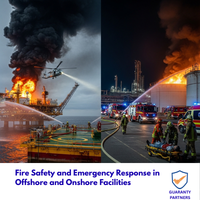
Fire Safety and Emergency Response in Offshore and Onshore Facilities

Course Overview

  • Understand the principles of fire safety in both offshore and onshore facilities.
  • Learn the emergency response protocols for fire incidents.
  • Identify key firefighting equipment and techniques for various facilities.
  • Gain knowledge of evacuation procedures and safety measures in high-risk environments.

Training Format:In-class, Virtual, In-house

Location:Lagos, Accra, Nairobi, Kigali

Language:English, French

Nigeria Price:
₦360000

Int'l., (Nigeria) Price:
$1000

Ghana Price:
$4000

Kenya Price:
$5500

Rwanda Price:
$6000

Nigeria Price:₦360000

Int'l., (Nigeria) Price:
$1000

Ghana Price:
$4000

Kenya Price:
$4000

Rwanda Price:
$4000

Nigeria Price: ₦360000

Int'l., (Nigeria) Price:
$1000

Ghana Price: $4000

Kenya Price: $4000

Rwanda Price: $4000

Fire Safety Basics and Regulations

  • Overview of fire safety principles
  • Key fire hazards in offshore and onshore environments
  • Fire safety regulations and standards (OSHA, NFPA, etc.)
  • Risk assessment and hazard identification
  • Role of fire safety in workplace safety culture

Fire Prevention and Detection Systems

  • Types of fire prevention systems
  • Fire detection systems: smoke, heat, and flame detectors
  • Installation and maintenance of fire detection systems
  • Fire suppression systems: water-based, foam, CO2, and dry chemical
  • Regular inspection and testing protocols

Emergency Response Procedures

  • Initial response to fire incidents
  • Firefighting team roles and responsibilities
  • Evacuation procedures: assembly points and safe exits
  • Communication systems during an emergency
  • First aid and medical response to fire-related injuries

Training and Drills for Fire Safety and Emergency Response

  • Importance of regular fire drills and simulations
  • Fire safety training for personnel
  • Practical firefighting training with live fire exercises
  • Evacuation drills and assembly point practice
  • Post-incident analysis and reporting

1ST BATCH: Tuesday, March 10, 2026 — Friday, March 13, 2026.

2ND BATCH: Tuesday, July 7, 2026 — Friday, July 10, 2026.

3RD BATCH: Tuesday, November 3, 2026 — Friday, November 6, 2026.

The training methodology integrates lectures, interactive discussions, collaborative group exercises, and
illustrative examples. Participants will acquire a blend of theoretical insights and hands-on practical
experience, emphasizing the application of learned techniques. This approach ensures that attendees return
to their professional environments equipped with both the competence and self-assurance to effectively
implement the acquired skills in their responsibilities.

Facebook
WhatsApp
X
Threads
Telegram
Print