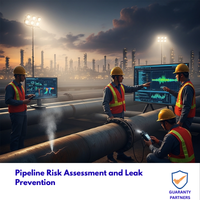
Pipeline Risk Assessment and Leak Prevention
Course Overview
- Understand the key concepts and importance of pipeline risk assessment.
- Learn to identify and evaluate risks associated with pipelines.
- Gain knowledge on the methods and technologies used for leak prevention.
- Develop strategies for mitigating risks and preventing leaks in pipeline systems.
Training Format:In-class, Virtual, In-house
Location:Lagos, Accra, Nairobi, Kigali
Language:English, French
Nigeria Price:
₦360000
Int'l., (Nigeria) Price:
$1000
Ghana Price:
$4000
Kenya Price:
$5500
Rwanda Price:
$6000
Nigeria Price:₦360000
Int'l., (Nigeria) Price:
$1000
Ghana Price:
$4000
Kenya Price:
$4000
Rwanda Price:
$4000
Nigeria Price: ₦360000
Int'l., (Nigeria) Price:
$1000
Ghana Price: $4000
Kenya Price: $4000
Rwanda Price: $4000
Introduction to Pipeline Risk Assessment
- Overview of pipeline systems and their significance
- Key risks in pipeline operations
- Risk assessment methodology and framework
- Risk management in pipeline design, operation, and maintenance
Risk Identification and Evaluation Techniques
- Hazard identification methods (e.g., failure modes, external threats)
- Risk evaluation techniques (e.g., qualitative and quantitative analysis)
- Risk ranking and prioritization
- Tools and software for pipeline risk assessment
Leak Prevention Technologies and Best Practices
- Overview of leak detection systems (e.g., pressure monitoring, acoustic sensors)
- Preventive measures for common pipeline leaks (e.g., corrosion, external damage)
- Pipeline maintenance and inspection practices
- Role of materials selection and pipeline coatings in leak prevention
1ST BATCH: Tuesday, February 10, 2026 — Friday, February 13, 2026.
2ND BATCH: Tuesday, June 2, 2026 — Friday, June 5, 2026.
3RD BATCH: Monday, September 28, 2026 — Wednesday, September 30, 2026.
The training methodology integrates lectures, interactive discussions, collaborative group exercises, and
illustrative examples. Participants will acquire a blend of theoretical insights and hands-on practical
experience, emphasizing the application of learned techniques. This approach ensures that attendees return
to their professional environments equipped with both the competence and self-assurance to effectively
implement the acquired skills in their responsibilities.