
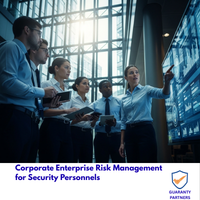
Corporate Enterprise Risk Management for Security Personnels
Course Overview
• Determine and master the concepts, approaches, standards, methods and techniques for the effective implementation of ERM
• Develop the necessary leadership skills enabling you to communicate your findings to all levels and all stakeholders
• Determine your organisation’s appetite and tolerance for risk
• Assess, report and monitor risks effectively.
• Identify, analyse and manage business risk effectively.
• Understand how ERM relates to crisis management, business continuity and business resilience
• Apply your invaluable and highly relevant ERM knowledge to put into practice and benefit you and your organisation immediately on returning
• Develop and implement a risk management strategy.
• Develop mitigations and contingency plans.
Training Format:In-class, Virtual, In-house
Location:Lagos, Accra, Nairobi, Kigali
Language:English, French
Nigeria Price:
₦3500000
Int'l., (Nigeria) Price:
$1000
Ghana Price:
$4000
Kenya Price:
$5500
Rwanda Price:
$6000
Nigeria Price:₦3500000
Int'l., (Nigeria) Price:
$1000
Ghana Price:
$4000
Kenya Price:
$4000
Rwanda Price:
$4000
Nigeria Price: ₦3500000
Int'l., (Nigeria) Price:
$1000
Ghana Price: $4000
Kenya Price: $4000
Rwanda Price: $4000
Principles of Risk and Enterprise Risk Management
• Objectives & Governance, concepts & definitions
• Mapping and assessing Your current governance arrangements
• Commitment – Setting Your objectives for implementing the latest guidance
• Who are the internal and external stakeholders?
• The importance of culture, communication and behaviour in seeking an effective ERM structure
• An overview of the global post pandemic business environment
• Enterprise Risk Management – The Resilient Organisation
ISO 31004 – Designing the Framework for Managing ERM
• ERM framework and process
• ERM responsibilities – who does what, who is on the team
• ERM accountabilities and performance measures
• Compare Your current ERM to ISO31000:2009 principles
• Alignment between ERM policy and the organization
• Risk attitude: pursue, retain or avoid with respect to risk appetite and tolerance
• Options for risk criteria, assessment, identification, analysis and evaluation
Business Continuity Management Systems (BCMS)
• Fundamental principles of Business Continuity Management
• Implementation of a BCMS in accordance with ISO 22301 & 27031
• Business Impact Analysis (BIA) and Risk Assessment
• To understand the relationship between BCMS and the compliance with the other ERM requirements, including supply chain strategies
• Writing a business case and a project plan for the implementation of a BCMS
• Incident and emergency response management (including mutual aid)
Implementing Effective Enterprise Risk Management
• Resources and methodologies to implement The Plan
• Ensuring ERM becomes part of significant decision-making
• What are the likely barriers to implementation (risk culture)?
• Risk reporting & the limitations of various risk reporting tools & methodologies
• Assess the merits of quantitative risk modelling & qualitative reporting
• Align your risk reporting processes with other strategically important management activities, such as reputation management
Monitoring, Review and Continuous Improvement of the Framework
• Key risk indicators (KRI´s)
• Continuous improvements, running your own team-based risk workshops
• Collate risk and control information from multiple sources into a central risk register or inventory of risk information system
• Controls register or inventory of controls (The “Five Ws”)
• Understand feedback provided to you by those you communicate with and take on board “lessons learnt”
1ST BATCH: Tuesday, February 17, 2026 — Friday, February 20, 2026.
2ND BATCH: Tuesday, June 16, 2026 — Friday, June 19, 2026.
3RD BATCH: Tuesday, October 13, 2026 — Friday, October 16, 2026.
The training methodology integrates lectures, interactive discussions, collaborative group exercises, and
illustrative examples. Participants will acquire a blend of theoretical insights and hands-on practical
experience, emphasizing the application of learned techniques. This approach ensures that attendees return
to their professional environments equipped with both the competence and self-assurance to effectively
implement the acquired skills in their responsibilities.