
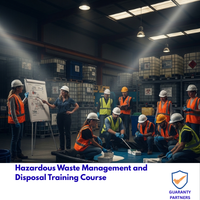
Hazardous Waste Management and Disposal Training Course
Course Overview
Upon completing this Hazardous Waste Management and Disposal Training Course successfully, participants will be able to:
• Identify the various types of contamination and distinguish the ones that apply to your company
• Support and facilitate conversations on specific contamination issues
• Learn about the pertinent environmental legislation for contamination and pollution
• Understand how to prioritise contamination problems and waste management issues in a logical sequence
• Discuss the impact of contamination on human health and the environment
• Evaluate the current practices used to clean up contaminated soil, water, air pollution, radioactive materials, and construction materials
Training Format:In-class, Virtual, In-house
Location:Lagos, Accra, Nairobi, Kigali
Language:English, French
Nigeria Price:
₦3500000
Int'l., (Nigeria) Price:
$1000
Ghana Price:
$4000
Kenya Price:
$5500
Rwanda Price:
$6000
Nigeria Price:₦3500000
Int'l., (Nigeria) Price:
$1000
Ghana Price:
$4000
Kenya Price:
$4000
Rwanda Price:
$4000
Nigeria Price: ₦3500000
Int'l., (Nigeria) Price:
$1000
Ghana Price: $4000
Kenya Price: $4000
Rwanda Price: $4000
INTRODUCTION TO HAZARDOUS WASTES
• Definition of hazardous wastes & non-hazardous wastes
• The relationship between contamination and hazardous wastes
• The toxic 12 chemicals and those that soon may be added to the toxic 12
• Environmental law and its significance
• The Moduleed Nations Environment Program (UNEP)
HISTORY OF CONTAMINATION
• What is contamination?
• What is the impact of contamination?
• Various types of contamination
• Environmental issues related to contamination
• International regulations and legislations related to contamination
MANAGEMENT OF CONTAMINATION AND HAZARDOUS WASTES
• Carrying out a contamination audit
• Contamination and its impact on occupational health & safety
• The role of documentation in hazardous waste management
• Some typical hazardous waste regulations and the need for harmonisation
• Workplace Hazardous Materials Information System (WHMIS)
• Material Safety Data Sheet (MSDS)
• Globally Harmonised System (GHS)
• Managing a waste disposal site
CONTAMINATION AND POLLUTION PREVENTION
• Exploration & Production
• Refining & Transportation
• Oil Spills
• Case Study – April 2010 Gulf of Mexico
• Modern tanker designs
• Other oil-related sources of pollution
• Zero Waste (ZW)
• Zero Liquid Discharge (ZLD)
• The Bird Problem
POLLUTION PREVENTION PLANNING
• Life Cycle Management of all equipment
• Reduce, Reuse, Recycle, Recover and Rethink – the 5 R’s
• Proper storage and disposal of hazardous materials
• The importance of ongoing training within organisations
CONTINGENCY PLANNING FOR MAJOR INCIDENTS
• Emergency plan sections and review cycles
• The influence of ISO 14001, 18001 and 9001 on hazardous waste management
• Types of environmental audits
• Preventable major accidents
EMERGENCY RESPONSE TO HAZARDOUS SUBSTANCE RELEASE
• Fundamentals of an emergency response plan
• Components in an emergency response plan
• Skilled support personnel
• Specialist employees
• Procedures for handling emergency response
• Training levels/programs
o First responder awareness level
o First responder operations level
o Hazardous materials technician
o Hazardous materials specialist
o On scene incident commander
o Refresher training
o Medical surveillance and consultation
• Personal Protective Equipment (PPE)
MANAGEMENT’S ROLE IN PREVENTION OF CONTAMINATION AND HAZARDOUS WASTES
• HAZID (HAZard IDentification)
• HAZOP (HAZard & OPerability)
• Environmental ethics
• Examples of environmental ethics
• Climate change update and its significance
• Making your company environmentally friendly at a reasonable cost
1ST BATCH: Tuesday, February 17, 2026 — Friday, February 20, 2026.
2ND BATCH: Tuesday, June 16, 2026 — Friday, June 19, 2026.
3RD BATCH: Tuesday, October 13, 2026 — Friday, October 16, 2026.
The training methodology integrates lectures, interactive discussions, collaborative group exercises, and
illustrative examples. Participants will acquire a blend of theoretical insights and hands-on practical
experience, emphasizing the application of learned techniques. This approach ensures that attendees return
to their professional environments equipped with both the competence and self-assurance to effectively
implement the acquired skills in their responsibilities.