

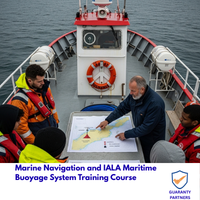
Marine Navigation and IALA Maritime Buoyage System Training Course
Course Overview
The main objective of this course is to empower marine professionals with—
• in-depth knowledge and information about IALA and the IALA Maritime Buoyage System
• extreme clarity of the objectives and activities of IALA and its benefit to marine organisations
• the required knowledge and experience to play an important role in driving one’s organisation to follow the guidelines, practices and indications of the IALA Maritime Buoyage System
• the adequate confidence and skill to innovate and provide ideas and suggestions to develop the system with new changes and technological evolution
• the necessary authority and exposure to partake in introducing critical guidelines and practices at an organisational level and play a significant role in aligning operations and navigational activity of the organisation to the requirements set out by IALA for its maritime buoyage system
• the required confidence, skill, capability and exposure to be part of the committees responsible for ensuring smooth navigation and seamless operation of the system
• the required ability and platform to contribute to one’s industry and ensure safety in movement at sea for all mariners
Training Format:In-class, Virtual, In-house
Location:Lagos, Accra, Nairobi, Kigali
Language:English, French
Nigeria Price:
₦3500000
Int'l., (Nigeria) Price:
$1000
Ghana Price:
$4000
Kenya Price:
$5500
Rwanda Price:
$6000
Nigeria Price:₦3500000
Int'l., (Nigeria) Price:
$1000
Ghana Price:
$4000
Kenya Price:
$4000
Rwanda Price:
$4000
Nigeria Price: ₦3500000
Int'l., (Nigeria) Price:
$1000
Ghana Price: $4000
Kenya Price: $4000
Rwanda Price: $4000
Overview of IALA
• Definition
• The IALA Maritime Buoyage System
• Regions A and B
Applicability of the Maritime Buoyage System
• Lateral limits of navigable channels
• Natural dangers and other obstructions (wrecks, etc.)
• Landfall, course to steer, etc.
• New dangers
Committees under IALA and their purpose
• ENAV – e-Navigation
• ARM – Aid to navigation requirements and management
• ENG – Engineering and sustainability
• VTS – Vessel traffic services
Different Aids to Navigation
• Lighthouses
• Lightships
• Beacons
• Buoys
Types of Marks for Vessel Pilotage
• Lateral marks
• Cardinal marks
• Isolated danger marks
• Safe water marks
• Special marks
• Emergency wreck marking buoy
Characteristics of Identification of Marks
• By night: colour and rhythm of light or illumination enhancement
• By day: colour, shape, top-mark, and/or light (colour and rhythm)
• By electronic (digital) symbology: as a complement to physical marks
• By electronic (digital) symbology alone
Types of Buoys
• Anchorage buoys
• Cautionary buoys
• Control buoys
• Hazard buoys
• Emergency wreck buoys
• Information buoys
• Mooring buoys
• Cardinal buoys
• Lateral buoys
• Weather buoys
• Swimming buoys, etc.
Types of Light Patterns and their Significance
• Fixed
• Flashing
• Quick flashing
• Very quick flashing
• Intercepted quick flashing
• Isophase
• Group flashing
• Occulting
• Alternating
• Long flashing
1ST BATCH: Monday, March 30, 2026 — Thursday, April 2, 2026.
2ND BATCH: Tuesday, July 21, 2026 — Friday, July 24, 2026.
3RD BATCH: Tuesday, November 17, 2026 — Friday, November 20, 2026.
The training methodology integrates lectures, interactive discussions, collaborative group exercises, and
illustrative examples. Participants will acquire a blend of theoretical insights and hands-on practical
experience, emphasizing the application of learned techniques. This approach ensures that attendees return
to their professional environments equipped with both the competence and self-assurance to effectively
implement the acquired skills in their responsibilities.