
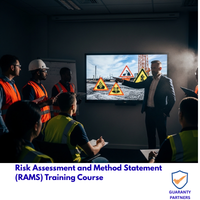
Risk Assessment and Method Statement (RAMS) Training Course
Course Overview
Upon completing this Risk Assessment and Method Statement (RAMS) Training Course successfully, participants will be able to:
• Learn how to write effective RAMS and become familiar with its contents
• Learn how to collate risk assessments and specific methods of work that stand out from competitors
• Devise risk assessments and method statements that organisations can understand and follow easily
• Understand your legal obligations in terms of health and safety RAMS
• Learn and practice how to conduct and record a risk assessment
• Recognise how to spot common errors when reviewing method statements
• Take preventative and protective control measures to ensure optimum health and safety compliance
Training Format:In-class, Virtual, In-house
Location:Lagos, Accra, Nairobi, Kigali
Language:English, French
Nigeria Price:
₦3500000
Int'l., (Nigeria) Price:
$1000
Ghana Price:
$4000
Kenya Price:
$5500
Rwanda Price:
$6000
Nigeria Price:₦3500000
Int'l., (Nigeria) Price:
$1000
Ghana Price:
$4000
Kenya Price:
$4000
Rwanda Price:
$4000
Nigeria Price: ₦3500000
Int'l., (Nigeria) Price:
$1000
Ghana Price: $4000
Kenya Price: $4000
Rwanda Price: $4000
BACKGROUND AND INTRODUCTION TO RISK
• Site Risk Assessments and Method Statements (RAMS)
o History
o Legal Requirements
o Definitions
• What is Risk?
o Risk
o Likelihood
• Risks vs. Issues
• What is a Risk Assessment?
THE IMPORTANCE OF RISK ASSESSMENT
• Why is Risk Assessment Important?
• The Aim of Risk Assessment
• Principles of Prevention
• Risk Score Calculator
• Specific Task Risk Assessment
RISK ASSESSMENT METHODS
• Five steps to Risk Assessment
• Types of Risk Assessment
• Defining Practical and Realistic Control Measures
• Qualitative vs. Quantitative Risk Assessment Methods
METHOD STATEMENTS
• What is a Method Statement?
• Difference between Risk Assessment and Method Statement
• The requirements of a method statement
• Method Statement Form
• Defining Sequence of Works (Step by Step)
• Standard vs. Task Specific Risk Assessments and Method Statements (RAMS)
• Keeping Records
• Permits to Work
• What Are the Tasks Involved?
o Hazards
o Risks
• How Will Hazards and Risks Be Controlled?
REVIEWING AND APPROVALS OF RAMS
• Effective Communication of RAMS policies
• Implementation of Control Measures
• Dynamic Risk Assessments
• Reviewing and Updating RAMS
• Approving RAMS
EXAMPLES
• Safe Work Method Statement Example
• The Role of H&S Managers and Coordinators in RAMS
• Welfare, Personal Protection, and Emergency Procedures
• The Consequences of Working without ‘RAMS’
PRACTICE RISK ASSESSMENTS AND METHOD STATEMENTS
• Prepare Risk Assessments
• Prepare Safety Method Statements
• Recognise Where HSE Enforced Action Would Be Taken
• Discuss Futuristic Measures of Control
1ST BATCH: Tuesday, February 24, 2026 — Friday, February 27, 2026.
2ND BATCH: Tuesday, June 23, 2026 — Friday, June 26, 2026.
3RD BATCH: Tuesday, October 20, 2026 — Friday, October 23, 2026.
The training methodology integrates lectures, interactive discussions, collaborative group exercises, and
illustrative examples. Participants will acquire a blend of theoretical insights and hands-on practical
experience, emphasizing the application of learned techniques. This approach ensures that attendees return
to their professional environments equipped with both the competence and self-assurance to effectively
implement the acquired skills in their responsibilities.