
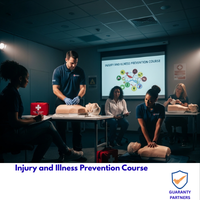
Injury and Illness Prevention Course
Course Overview
At the end of this Injury and Illness Prevention (IIP) Training Course successfully, participants will be able to:
• Identify the IIP injury and illness prevention requirements
• Describe the significance of an Injury and Illness Prevention Program (IIP) in preventing injuries and illnesses
• Learn the various elements of a successful IIP
• Discover how to investigate work-related accidents and injuries
• Develop compliance strategies
• Maintain documentation for health and safety programs
• Work collaboratively with other participants to design workplace hazard protocols
• Improve your overall personal safety and health at the workplace
Training Format:In-class, Virtual, In-house
Location:Lagos, Accra, Nairobi, Kigali
Language:English, French
Nigeria Price:
₦3500000
Int'l., (Nigeria) Price:
$1000
Ghana Price:
$4000
Kenya Price:
$5500
Rwanda Price:
$6000
Nigeria Price:₦3500000
Int'l., (Nigeria) Price:
$1000
Ghana Price:
$4000
Kenya Price:
$4000
Rwanda Price:
$4000
Nigeria Price: ₦3500000
Int'l., (Nigeria) Price:
$1000
Ghana Price: $4000
Kenya Price: $4000
Rwanda Price: $4000
Incident Investigation: The Basics
• Why call the situation an incident instead of an “accident”?
• Incident types
• Why do we conduct an Incident Investigation?
• Incident Investigation Programs that work
• When OSHA conducts Incident Investigation:
• Case scenarios
• The fines
• Avoiding citations, penalties, and fines
Why do bad things happen to good employers?
• Initiating the investigation
• Securing the scene
• When to start your incident investigation
• Reporting Incident to OSHA
• Reporting vs Recording
• What should I report?
Methods Of Documenting the Incident Scene
• Personal observations
• Getting initial statements and taking pictures
• Taking videos and sketching a scene
• Interviewing our records
Conducting Effective Interviews
• The interview processes
• Preparing for the interview
• Who should be interviewed?
• Bad interview vs. Good interview
Conducting Event Analysis
• Surface cause vs Root cause
• Employing the “Multiple Event” theory to avoid future incidents
• Developing the sequence of events
• Sample sequence of events
Root Cause Analysis
• Difference between the surface and root causes
• Describing direct causes
• Sample tools for Root Cause Analysis
• System analysis
Developing Solutions and Recommendations
• How to get upper management’s support?
• OSHA’s hierarchy of controls
• Recommending system improvements
• The “6 Question” approach for designing solutions and recommendations
• The direct and indirect cost of incidents
• Safety pays
Writing The Incident Report
• Who is your audience?
• Roles and responsibilities
• Order and sections of the incident report
• Important sections of the incident report
Practical Application
• Case scenarios
• Role-playing activities
The Eight Core Elements of Iip
• Responsibility
• Compliance
• Communication
• Hazard Assessment
• Accident Investigation
• Hazard Correction
• Training and Instruction
• Record-keeping
Costs of Workplace Injuries
• Physical, financial, and emotional hardship
• Workers’ compensation benefits
• Medical insurance
• Loss of employment and wages
• Burdensome debt
• Incapability to satisfy the cost of living
• Loss of homeownership
• Bankruptcy
• Wages paid to injured workers for absences
• Wage costs related to a work stoppage
• Administrative time spent by supervisors following injuries
• Employee training and replacement costs
• Lost productivity due to new employee learning curves
• Accommodation of injured employees
• Replacement costs of impaired material, equipment, or premises
FOR WHOM:
Industrial Hygienists, Safety Engineers, Health and Safety Professionals, Union Representatives, Risk Managers, Loss Control Specialists, Management Health and Safety Committee Members, Supervisors, All employees with HSE responsibilities.
1ST BATCH: Tuesday, January 13, 2026 — Friday, January 16, 2026.
2ND BATCH: Tuesday, May 5, 2026 — Friday, May 8, 2026.
3RD BATCH: Tuesday, September 1, 2026 — Friday, September 4, 2026.
The training methodology integrates lectures, interactive discussions, collaborative group exercises, and
illustrative examples. Participants will acquire a blend of theoretical insights and hands-on practical
experience, emphasizing the application of learned techniques. This approach ensures that attendees return
to their professional environments equipped with both the competence and self-assurance to effectively
implement the acquired skills in their responsibilities.