
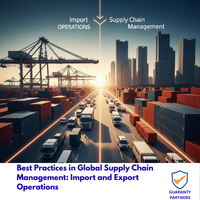
Best Practices in Global Supply Chain Management: Import and Export Operations
Course Overview
• Understand the fundamentals of global supply chain management (SCM) and its significance in international trade.
• Learn the key concepts and principles of import and export operations.
• Explore best practices and strategies for optimizing import and export processes.
• Develop skills to effectively manage customs compliance, documentation, and regulations.
• Gain insights into risk management strategies and techniques for international trade.
• Understand the role of technology and digitalization in enhancing import and export operations.
• Learn how to leverage global partnerships and networks to enhance supply chain efficiency.
• Acquire knowledge of sustainability practices and ethical considerations in global SCM.
Training Format:In-class, Virtual, In-house
Location:Lagos, Accra, Nairobi, Kigali
Language:English, French
Nigeria Price:
₦3000000
Int'l., (Nigeria) Price:
$1000
Ghana Price:
$4000
Kenya Price:
$5500
Rwanda Price:
$6000
Nigeria Price:₦3000000
Int'l., (Nigeria) Price:
$1000
Ghana Price:
$4000
Kenya Price:
$4000
Rwanda Price:
$4000
Nigeria Price: ₦3000000
Int'l., (Nigeria) Price:
$1000
Ghana Price: $4000
Kenya Price: $4000
Rwanda Price: $4000
Introduction to Global Supply Chain Management
• Overview of supply chain management (SCM) concepts
• Importance of global SCM in modern business
• Key challenges and opportunities in global supply chains
Fundamentals of Import and Export Operations
• Basics of international trade and commerce
• Differences between imports and exports
• Roles of importers, exporters, and intermediaries
Import and Export Documentation and Compliance
• Import/export documentation requirements
• Customs clearance procedures
• Compliance with import/export regulations and laws
Freight Forwarding and Logistics
• Role of freight forwarders and logistics providers
• Modes of transportation in international trade
• Incoterms and their implications for import/export transactions
Risk Management in Global Trade
• Identification and assessment of import/export risks
• Strategies for managing currency, legal, and political risks
• Insurance and risk mitigation techniques
Technology and Digitalization in Import/Export
• Digital platforms for trade facilitation
• Electronic documentation and customs clearance systems
• Blockchain technology in supply chain management
Global Trade Finance and Payment Methods
• Trade finance options for importers and exporters
• Letters of credit (LCs), bills of exchange, and other payment methods
• Managing currency exchange and forex risks
Supply Chain Sustainability and Ethics
• Sustainable practices in global SCM
• Ethical considerations in sourcing and procurement
• Corporate social responsibility (CSR) in international trade
Global Supply Chain Collaboration
• Building and managing global supplier relationships
• Collaborative planning and forecasting with international partners
• Supplier performance management and continuous improvement
Case Studies and Best Practices
• Real-world case studies of successful import/export operations
• Best practices in global supply chain management
• Lessons learned from industry leaders in import/export best practices
Future Trends in Global SCM
• Emerging trends and technologies shaping global supply chains
• Implications of geopolitical shifts and trade agreements
• Future challenges and opportunities in global SCM
FOR WHOM:
New, mid-level and experienced purchasing professionals, including global supply chain executives; import and export operations personnel; traffic and logistics managers; purchasing professionals; legal and finance professionals (controllers).
1ST BATCH: Tuesday, April 7, 2026 — Thursday, April 2, 2026.
2ND BATCH: Tuesday, July 28, 2026 — Friday, July 31, 2026.
3RD BATCH: Tuesday, November 24, 2026 — Friday, November 27, 2026.
The training methodology integrates lectures, interactive discussions, collaborative group exercises, and
illustrative examples. Participants will acquire a blend of theoretical insights and hands-on practical
experience, emphasizing the application of learned techniques. This approach ensures that attendees return
to their professional environments equipped with both the competence and self-assurance to effectively
implement the acquired skills in their responsibilities.