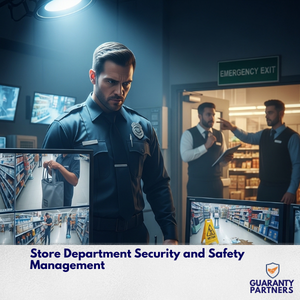
Store Department Security and Safety Management
Course Overview
• Understand the importance of security and safety measures in the store department.
• Identify potential security threats and risks associated with store operations.
• Develop strategies to mitigate security risks and ensure the safety of personnel and assets.
• Implement effective security protocols and procedures to prevent theft, vandalism, and unauthorized access.
• Train store personnel on security awareness and emergency response protocols.
• Ensure compliance with regulatory standards and industry best practices for store security and safety.
• Improve overall store department efficiency and productivity through effective security and safety management practices.
Training Format:In-class, Virtual, In-house
Location:Lagos, Accra, Nairobi, Kigali
Language:English, French
Nigeria Price:
₦3000000
Int'l., (Nigeria) Price:
$1000
Ghana Price:
$4000
Kenya Price:
$5500
Rwanda Price:
$6000
Nigeria Price:₦3000000
Int'l., (Nigeria) Price:
$1000
Ghana Price:
$4000
Kenya Price:
$4000
Rwanda Price:
$4000
Nigeria Price: ₦3000000
Int'l., (Nigeria) Price:
$1000
Ghana Price: $4000
Kenya Price: $4000
Rwanda Price: $4000
Introduction to Store Department Security and Safety
• Importance of security and safety in the store department
• Legal and regulatory requirements for store security and safety
• Roles and responsibilities of store personnel in maintaining security and safety
Risk Assessment and Threat Identification
• Conducting risk assessments for the store department
• Identifying potential security threats and vulnerabilities
• Understanding common security risks in store operations
Security Measures and Protocols
• Access control measures and entry/exit procedures
• Surveillance systems and CCTV monitoring
• Alarm systems and intrusion detection
• Locking mechanisms and key control procedures
Loss Prevention Strategies
• Inventory management techniques to prevent shrinkage and loss
• Employee theft prevention programs and policies
• External theft prevention strategies
• Vendor and supplier security protocols
Emergency Preparedness and Response
• Developing emergency response plans for the store department
• Fire safety procedures and evacuation plans
• First aid and medical emergency protocols
• Crisis communication and coordination with emergency services
Security Training and Awareness
• Security awareness training for store personnel
• Recognizing suspicious behavior and potential security threats
• Reporting procedures for security incidents and emergencies
Regulatory Compliance and Best Practices
• Compliance with Occupational Safety and Health Administration (OSHA) regulations
• Industry standards and best practices for store security and safety
• Auditing and monitoring store security measures for effectiveness
Technology Solutions for Store Security
• Implementing technology solutions for store security and safety
• Electronic article surveillance (EAS) systems
• RFID inventory tracking systems
• Mobile security applications and remote monitoring tools
Physical Security Measures
• Store layout and design considerations for security
• Perimeter security measures
• Securing entrances, exits, and loading docks
• Lighting, fencing, and landscaping for crime prevention
Case Studies and Lessons Learned
• Real-world case studies illustrating successful store security and safety practices
• Lessons learned from security incidents and near-misses
• Best practices for continuous improvement in store department security and safety management
FOR WHOM:
Stores, Purchasing and Logistics Personnel in the Public and Private Sectors.
1ST BATCH: Tuesday, February 10, 2026 — Friday, February 13, 2026.
2ND BATCH: Tuesday, June 2, 2026 — Friday, June 5, 2026.
3RD BATCH: Monday, September 28, 2026 — Wednesday, September 30, 2026.
The training methodology integrates lectures, interactive discussions, collaborative group exercises, and
illustrative examples. Participants will acquire a blend of theoretical insights and hands-on practical
experience, emphasizing the application of learned techniques. This approach ensures that attendees return
to their professional environments equipped with both the competence and self-assurance to effectively
implement the acquired skills in their responsibilities.