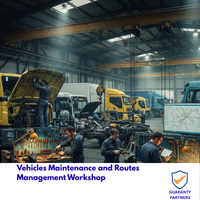
The Vehicle maintenance and routes Management training course will examine the transportation function in a holistic manner. The training will start by outlining the requirements of successful fleet maintenance programs and workshops. The training course then describes the components of stringent fleet and driver safety programs and experiment with different capital budgeting and distribution routing techniques. The training course will conclude with a thorough explanation of key fleet performance measures.
• Introduction to the vehicle maintenance and routes management • The role of players and stakeholders in the fleet management business. • General fleet management functions and operations (selection, procurement, cost management, etc). • Operational considerations: The 5 Critical Process Issues. • Understanding the fundamental principles of road transport: Justifying the need, cost and value-added in moving payload. • Factors most likely to influence the value outcomes: The Anatomy of a Fleet Operating Environment. • Procurement, contract management and tenders. • Risk management
The training methodology integrates lectures, interactive discussions, collaborative group exercises, and illustrative examples. Participants will acquire a blend of theoretical insights and hands-on practical experience, emphasizing the application of learned techniques. This approach ensures that attendees return to their professional environments equipped with both the competence and self-assurance to effectively implement the acquired skills in their responsibilities.