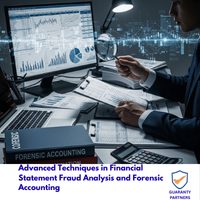
Advanced Techniques in Financial Statement Fraud Analysis and Forensic Accounting

Course Overview

• Comprehensive Understanding: Gain a deep understanding of financial statement fraud and forensic accounting principles.
• Detection Skills: Develop advanced skills to detect and analyze financial statement fraud using forensic accounting techniques.
• Investigative Techniques: Learn effective investigative techniques to uncover fraudulent activities within financial statements.
• Risk Assessment: Explore methods for assessing and mitigating the risk of financial statement fraud in organizations.
• Regulatory Compliance: Understand the regulatory framework surrounding financial statement fraud and compliance requirements.
• Case Studies: Analyze real-world case studies and examples to apply theoretical knowledge to practical situations.
• Reporting and Communication: Learn how to effectively report findings and communicate insights regarding financial statement fraud analysis.

Training Format:In-class, Virtual, In-house

Location:Lagos, Accra, Nairobi, Kigali

Language:English, French

Nigeria Price:
₦300000

Int'l., (Nigeria) Price:
$1000

Ghana Price:
$4000

Kenya Price:
$5500

Rwanda Price:
$6000

Nigeria Price:₦300000

Int'l., (Nigeria) Price:
$1000

Ghana Price:
$4000

Kenya Price:
$4000

Rwanda Price:
$4000

Nigeria Price: ₦300000

Int'l., (Nigeria) Price:
$1000

Ghana Price: $4000

Kenya Price: $4000

Rwanda Price: $4000

Introduction to Financial Statement Fraud
• Definition and types of financial statement fraud
• Impact of financial statement fraud on stakeholders
• Regulatory environment and compliance standards

Forensic Accounting Fundamentals
• Principles and techniques of forensic accounting
• Role of forensic accountants in fraud detection and investigation
• Ethical considerations in forensic accounting

Red Flags and Warning Signs
• Common indicators of financial statement fraud
• Behavioral red flags in financial reporting
• Techniques for identifying anomalies and irregularities

Procedures and Data Analytics
• Use of analytical procedures in fraud detection
• Application of data analytics tools and techniques
• Data mining and trend analysis for fraud identification

Investigative Techniques
• Interviewing techniques for fraud investigations
• Document examination and evidence gathering
• Chain of custody and preservation of evidence

Fraud Risk Assessment and Internal Controls
• Assessing fraud risk within organizations
• Designing and implementing effective internal controls
• Fraud prevention and deterrence strategies

Regulatory Compliance and Legal Framework
• Overview of relevant laws and regulations
• Compliance requirements for financial reporting
• Role of regulatory agencies in fraud detection and enforcement

Case Studies and Practical Applications
• Analysis of real-world financial statement fraud cases
• Application of forensic accounting techniques to case scenarios
• Group exercises and discussions to reinforce learning

Reporting and Communication
• Documentation of findings and evidence
• Writing effective fraud investigation reports
• Presenting findings to stakeholders and management

FOR WHOM:
Internal audit staff and management, Financial auditors, Internal control professionals, Accounting staff.

1ST BATCH: Tuesday, February 10, 2026 — Friday, February 13, 2026.

2ND BATCH: Tuesday, June 2, 2026 — Friday, June 5, 2026.

3RD BATCH: Monday, September 28, 2026 — Wednesday, September 30, 2026.

The training methodology integrates lectures, interactive discussions, collaborative group exercises, and
illustrative examples. Participants will acquire a blend of theoretical insights and hands-on practical
experience, emphasizing the application of learned techniques. This approach ensures that attendees return
to their professional environments equipped with both the competence and self-assurance to effectively
implement the acquired skills in their responsibilities.

Facebook
WhatsApp
X
Threads
Telegram
Print