
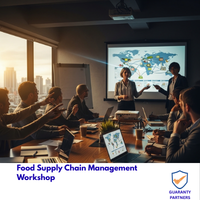
Food Supply Chain Management Workshop
Course Overview
Food Supply Chain Management and Logistics Training course aims to provide particpants with the necessary technical knowledge in order to support the safe production of food within their roles. The course acknowledges the importance of a holistic, all-encompassing farm-to-fork supply chain focus across the food sector.
Training Format:In-class, Virtual, In-house
Location:Lagos, Accra, Nairobi, Kigali
Language:English, French
Nigeria Price:
₦3000000
Int'l., (Nigeria) Price:
$1000
Ghana Price:
$4000
Kenya Price:
$5500
Rwanda Price:
$6000
Nigeria Price:₦3000000
Int'l., (Nigeria) Price:
$1000
Ghana Price:
$4000
Kenya Price:
$4000
Rwanda Price:
$4000
Nigeria Price: ₦3000000
Int'l., (Nigeria) Price:
$1000
Ghana Price: $4000
Kenya Price: $4000
Rwanda Price: $4000
Food Production
• Entities in the agriculture supply chain.
• Agriculture and poverty alleviation.
• The barriers to the development of the agri-industry.
• Future steps for the agriculture sector.
• Case example: Cargill works with producers on finance and risk management.
• Case example: Nestlé works with dairy farmers.
• Case example: ITC Ltd India empowers farmers through technology.
• Case example: Microfinance models within the food sector.
Food Manufacturing
• The importance of food processing.
• Changing market conditions.
• Food processing.
• Food packaging.
• Inventory management.
• Food safety.
• Procurement.
Operational challenges – Food retailing
• The retail environment.
• How does the food reach the consumer?
• Online grocery retailing.
• Challenges to the future of food retailing.
• Case example: Retailers turning more to ‘dark stores’.
Food Logistics
• Movement of food.
• ICT future trends in agri-food logistics.
• Packaging in logistics.
• Temperature-controlled supply chains.
Challenges in international food supply chains
• International food supply chains.
• Factors affecting the future of international food systems.
• Managing challenges in international food supply chains.
• International politics and food 91.
• Collaboration and relationships.
• Trends in supply chain relationships.
• Current relationship models within the food sector.
• Other trends within supply chain collaboration.
Food sourcing and procurement
• Sourcing.
• Sourcing models.
• Purchasing models.
• Supplier segmentation.
• Supplier development.
• Strategic sourcing.
• Sustainable procurement.
Risk management
• Risk management and uncertainty.
• Risks in the supply chain.
• Risks in the food supply chain.
• Managing supply chain risks.
• Managing risks in food supply chains.
Technology trends in food supply chains
• Traceability and use of technology.
• Food production.
• Food processing in a technological context.
• Food packaging in a technological context.
• Food logistics.
1ST BATCH: Tuesday, March 10, 2026 — Friday, March 13, 2026.
2ND BATCH: Tuesday, June 30, 2026 — Friday, July 3, 2026.
3RD BATCH: Tuesday, October 27, 2026 — Friday, October 30, 2026.
The training methodology integrates lectures, interactive discussions, collaborative group exercises, and
illustrative examples. Participants will acquire a blend of theoretical insights and hands-on practical
experience, emphasizing the application of learned techniques. This approach ensures that attendees return
to their professional environments equipped with both the competence and self-assurance to effectively
implement the acquired skills in their responsibilities.