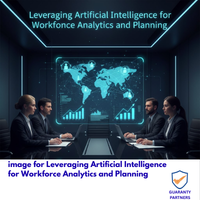
Leveraging Artificial Intelligence for Workforce Analytics and Planning

Course Overview

  • Understand the fundamentals of workforce analytics and its role in organizational planning.
  • Explore how artificial intelligence (AI) enhances workforce analytics and decision-making.
  • Develop practical skills to implement AI-driven workforce planning tools.
  • Evaluate and address ethical and data privacy concerns in AI applications.

Training Format:In-class, Virtual, In-house

Location:Lagos, Accra, Nairobi, Kigali

Language:English, French

Nigeria Price:
₦330000

Int'l., (Nigeria) Price:
$1000

Ghana Price:
$4000

Kenya Price:
$5500

Rwanda Price:
$6000

Nigeria Price:₦330000

Int'l., (Nigeria) Price:
$1000

Ghana Price:
$4000

Kenya Price:
$4000

Rwanda Price:
$4000

Nigeria Price: ₦330000

Int'l., (Nigeria) Price:
$1000

Ghana Price: $4000

Kenya Price: $4000

Rwanda Price: $4000

Introduction to Workforce Analytics and AI

  • Overview of workforce analytics and its importance in business strategy.
  • Basics of artificial intelligence and its relevance to workforce planning.
  • Key data sources for workforce analytics.
  • Case studies: Companies leveraging AI for workforce optimization.

AI Tools and Techniques in Workforce Analytics

  • Overview of AI technologies used in workforce analytics (e.g., machine learning, predictive analytics).
  • Applications of AI:
    • Talent acquisition and recruitment.
    • Employee performance and retention analysis.
    • Succession planning and skills gap identification.
  • Hands-on activity: Exploring workforce analytics dashboards/tools.

Implementing AI for Workforce Planning

  • Steps to integrate AI into workforce planning processes.
  • Building AI models: Key considerations and challenges.
  • Change management and training for AI adoption.
  • Interactive discussion: Barriers to implementation and how to overcome them.

Ethical Considerations and Future Trends

  • Addressing data privacy and ethical concerns in AI-driven analytics.
  • Bias in AI: Identification and mitigation strategies.
  • Future trends in workforce analytics and the role of generative AI.
  • Final group activity: Drafting an AI-driven workforce planning roadmap for a hypothetical organization.

1ST BATCH: Monday, March 30, 2026 — Thursday, April 2, 2026.

2ND BATCH: Tuesday, July 21, 2026 — Friday, July 24, 2026.

3RD BATCH: Tuesday, November 17, 2026 — Friday, November 20, 2026.

The training methodology integrates lectures, interactive discussions, collaborative group exercises, and
illustrative examples. Participants will acquire a blend of theoretical insights and hands-on practical
experience, emphasizing the application of learned techniques. This approach ensures that attendees return
to their professional environments equipped with both the competence and self-assurance to effectively
implement the acquired skills in their responsibilities.

Facebook
WhatsApp
X
Threads
Telegram
Print