
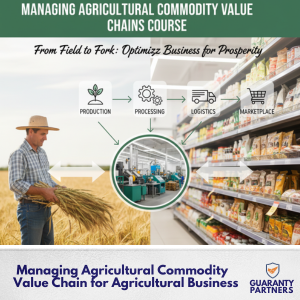
Managing Agricultural Commodity Value Chain for Agricultural Business
Course Overview
• Understand the agricultural commodity value chain and its components.
• Learn how to manage each stage of the value chain to maximize efficiency and profitability.
• Gain insights into the role of stakeholders in the agricultural commodity value chain.
• Develop strategies for improving supply chain management in agricultural businesses.
Training Format:In-class, Virtual, In-house
Location:Lagos, Accra, Nairobi, Kigali
Language:English, French
Nigeria Price:
₦350000
Int'l., (Nigeria) Price:
$1000
Ghana Price:
$4000
Kenya Price:
$5500
Rwanda Price:
$6000
Nigeria Price:₦350000
Int'l., (Nigeria) Price:
$1000
Ghana Price:
$4000
Kenya Price:
$4000
Rwanda Price:
$4000
Nigeria Price: ₦350000
Int'l., (Nigeria) Price:
$1000
Ghana Price: $4000
Kenya Price: $4000
Rwanda Price: $4000
Introduction to Agricultural Commodity Value Chains
• Definition and importance of value chains in agriculture.
• Key components of the agricultural commodity value chain (production, processing, distribution, retail).
• Overview of the value chain in various agricultural commodities (crops, livestock, fisheries).
• Understanding market dynamics and demand-supply relationships.
Managing the Production Stage of the Value Chain
• Key practices in crop and livestock production for commodity value chains.
• Importance of input management (seeds, fertilizers, equipment).
• Farm management strategies for improving productivity.
• Role of technology and innovation in production.
• Addressing challenges in the production stage (climate change, pests, diseases).
Processing and Value Addition
• Importance of post-harvest handling and processing in the value chain.
• Types of processing methods for different agricultural commodities.
• Strategies for improving quality and adding value to raw agricultural products.
• Marketing processed goods and understanding consumer preferences.
• The role of standards, certifications, and regulations in processing.
Supply Chain Management and Stakeholder Collaboration
• Overview of supply chain management in agricultural business.
• Identifying key stakeholders in the agricultural value chain (farmers, processors, distributors, retailers, consumers).
• Strategies for improving collaboration and communication across the value chain.
• Risk management in the agricultural supply chain.
• Leveraging partnerships for efficient distribution and logistics.
1ST BATCH: Tuesday, April 14, 2026 — Friday, April 17, 2026.
2ND BATCH: Tuesday, August 4, 2026 — Friday, August 7, 2026.
3RD BATCH: Tuesday, December 1, 2026 — Friday, December 4, 2026.
The training methodology integrates lectures, interactive discussions, collaborative group exercises, and
illustrative examples. Participants will acquire a blend of theoretical insights and hands-on practical
experience, emphasizing the application of learned techniques. This approach ensures that attendees return
to their professional environments equipped with both the competence and self-assurance to effectively
implement the acquired skills in their responsibilities.